Starting or growing a plumbing company requires more than technical skills and quality workmanship. A clear plumbing contractor business plan gives you a practical roadmap for organizing your services, understanding your target market, managing costs, attracting customers, and building sustainable revenue. Whether you are launching a new plumbing business or expanding an established contracting company, a well-prepared plan can help turn your ideas into measurable business goals.
A good business plan also helps you make informed decisions before investing heavily in equipment, vehicles, employees, marketing, or additional services. By documenting your business strategy in one place, you can identify opportunities, anticipate challenges, and establish realistic financial targets.
What Is a Plumbing Contractor Business Plan?
A plumbing contractor business plan is a structured document that explains how a plumbing company will operate and generate revenue. It typically covers the company’s services, target customers, competitive environment, marketing strategy, operations, management structure, startup costs, pricing approach, and financial projections.
For a plumbing contractor, the plan should reflect the specific nature of the industry. Residential plumbing repairs, commercial installations, emergency services, remodeling projects, maintenance contracts, and new construction can all have different pricing structures, customer expectations, and operational requirements.
Instead of creating a plan filled with vague statements, focus on practical information that you can use to guide day-to-day decisions and long-term growth.
Key Sections of a Plumbing Contractor Business Plan
1. Executive Summary
The executive summary provides a concise overview of your plumbing company and its objectives. Although it appears at the beginning of the business plan, many owners find it easier to write this section after completing the other sections.
Include information such as your business name, location, primary services, target market, competitive advantage, mission, and financial goals. Keep the summary concise while giving readers a clear understanding of the business.
2. Company Description
Explain how your plumbing business will operate and what makes it different from other contractors in your market. Describe whether the company focuses on residential customers, commercial properties, construction projects, property management companies, or a combination of markets.
You can also describe your business structure, service area, ownership, experience, and growth objectives. If you plan to hire technicians or administrative staff, explain how those roles will support the company’s operations.
3. Plumbing Services
Clearly define the services you intend to offer. A focused service list makes it easier to establish pricing, purchase equipment, train employees, and market your company.
Common plumbing contractor services may include:
- Residential plumbing installation and repair
- Commercial plumbing installation and maintenance
- Emergency plumbing services
- Drain cleaning and blockage removal
- Leak detection and repair
- Water heater installation and repair
- Bathroom and kitchen plumbing
- Pipe replacement and repiping
- Plumbing services for remodeling projects
- Preventive plumbing maintenance
You do not necessarily need to offer every service from the beginning. Consider your team’s experience, equipment, licensing requirements, local demand, and expected profit margins when deciding which services to prioritize.
4. Market Analysis
Your market analysis should explain who needs your plumbing services and how customers currently choose contractors. Research the local housing market, commercial development, construction activity, property management sector, and competing plumbing companies.
Define your ideal customers. For example, a residential plumbing contractor may focus on homeowners and landlords, while a commercial contractor may target restaurants, offices, retail properties, apartment complexes, and construction companies.
Consider the following questions:
- Who are your most valuable potential customers?
- Which plumbing services have consistent local demand?
- Who are your major competitors?
- What services or customer experiences do competitors provide?
- What geographic area can your team serve efficiently?
- What factors influence customers when selecting a plumbing contractor?
This information can help you identify a clear market position instead of trying to compete with every plumbing company on every type of project.
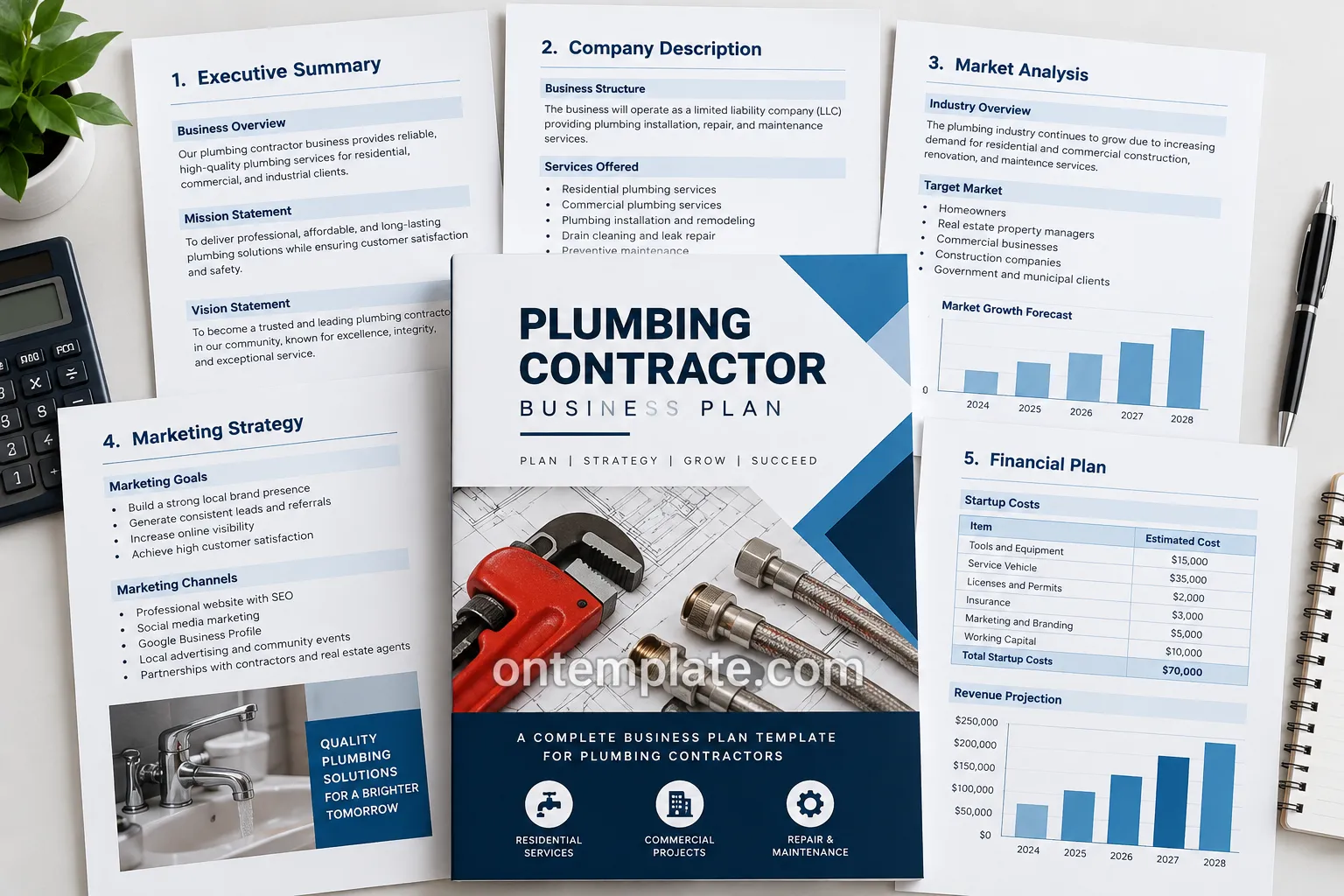
Image Title:
Alt Text:
Image Caption: A clean, professional plumbing contractor business plan template designed to organize business strategy, marketing, operations, and financial projections.
Developing a Plumbing Contractor Marketing Strategy
A strong marketing strategy should make it easy for potential customers to discover your company and understand why they should contact you. For local plumbing businesses, visibility and trust are particularly important because customers often need a contractor who can respond quickly and provide reliable workmanship.
Build a Professional Online Presence
Create a professional website that clearly displays your services, service area, contact information, business credentials, and customer reviews. Create individual pages for important services and locations when appropriate, while keeping the content genuinely useful rather than creating repetitive pages simply for search engines.
Local search optimization can also help customers find your business when they search for terms such as “plumber near me,” “residential plumbing contractor,” “emergency plumber,” or “commercial plumbing services.”
Use Local Marketing Channels
In addition to your website, consider marketing channels that connect your company with customers in your service area. These may include local business listings, referral programs, community organizations, social media, partnerships with property managers, and relationships with remodeling or construction companies.
Customer reviews can also play an important role in building credibility. Encourage satisfied customers to leave honest feedback and respond professionally to both positive and negative reviews.
Creating an Operations Plan
Your operations plan explains how your plumbing company will deliver services efficiently. It should cover scheduling, dispatching, equipment, vehicles, inventory, suppliers, employees, safety procedures, customer communication, and job documentation.
For example, establish a consistent process from the first customer inquiry through job completion. A typical workflow might include:
- Receiving and recording the customer inquiry
- Determining the type and urgency of the plumbing problem
- Scheduling the appropriate technician
- Preparing tools, parts, and equipment
- Providing the customer with a clear estimate or pricing information
- Completing and documenting the work
- Collecting payment and issuing an invoice
- Following up when appropriate
Standardized processes can reduce missed appointments, unnecessary trips, inventory problems, and communication errors.
Pricing and Financial Planning
Financial planning is one of the most important components of a plumbing contractor business plan. Your revenue must cover labor, materials, vehicle expenses, insurance, licensing, equipment, marketing, administrative costs, taxes, and other operating expenses while leaving room for profit and future investment.
Estimate Startup Costs
Startup expenses can vary significantly depending on the size and type of plumbing business. Potential costs include:
- Plumbing tools and specialized equipment
- Service vehicles
- Licenses and permits
- Insurance
- Office and communication equipment
- Website development and branding
- Advertising and marketing
- Initial inventory and materials
- Accounting and business software
- Working capital
Separate one-time startup costs from recurring monthly expenses. This distinction makes it easier to calculate how much capital the company needs before reaching consistent positive cash flow.
Set a Sustainable Pricing Strategy
Your pricing model should reflect your costs, market conditions, service complexity, and desired margins. Some plumbing companies use hourly labor rates, while others use flat-rate pricing for specific services. A combination of pricing methods may be appropriate depending on the work performed.
Track actual job costs over time. Comparing estimated labor hours and materials with the final figures can help you improve future estimates and identify services that generate stronger margins.
Setting Business Goals and Performance Metrics
A business plan becomes more useful when it includes measurable goals. Instead of simply stating that you want to “grow the plumbing business,” define what growth means and how you will measure it.
Useful plumbing business metrics can include:
- Monthly revenue
- Number of completed jobs
- Average revenue per job
- Lead-to-customer conversion rate
- Repeat customer rate
- Customer acquisition cost
- Gross profit margin
- Outstanding invoices
- Technician utilization
- Marketing-generated leads
Review these numbers regularly. If revenue increases but operating costs increase even faster, the business may need to adjust pricing, scheduling, purchasing, or service mix.
Common Mistakes to Avoid
Many new contractors create a business plan only because a lender or investor requests one. This can result in a document that looks professional but does not help with actual business decisions.
Avoid these common mistakes:
- Using unrealistic revenue projections
- Underestimating equipment and vehicle expenses
- Ignoring cash flow requirements
- Trying to serve every customer segment immediately
- Failing to research local competitors
- Setting prices without calculating total operating costs
- Neglecting marketing and customer retention
- Writing the plan once and never updating it
Your business plan should be a working document. Update financial projections, marketing strategies, staffing plans, and goals as your company gains new information and experience.
How a Plumbing Contractor Business Plan Template Can Help
Creating a business plan from a blank document can be time-consuming. A plumbing contractor business plan template provides a structured starting point so you can focus on the information that matters to your business.
A useful template can organize sections such as the executive summary, company description, services, market analysis, marketing plan, operations plan, and financial projections. It can also make it easier to present your strategy to potential business partners, lenders, investors, or advisors.
The key is to customize the template rather than treating it as a finished business plan. Replace generic assumptions with your actual service area, customer segments, pricing, operating costs, staffing plans, and financial targets.
Tips for Creating a Strong Plumbing Business Plan
- Keep assumptions realistic: Base forecasts on reasonable job volumes, pricing, operating capacity, and local market conditions.
- Know your numbers: Calculate labor, materials, overhead, vehicle costs, insurance, and other expenses before setting prices.
- Define your target customer: A clear customer profile makes marketing and sales activities more focused.
- Plan for slow periods: Maintain appropriate working capital and avoid relying entirely on optimistic revenue forecasts.
- Document your processes: Consistent scheduling, estimating, invoicing, and customer service procedures can support efficient growth.
- Review the plan regularly: Update it as your business, market, costs, and competitive environment change.
Conclusion
A well-structured plumbing contractor business plan can serve as a practical roadmap for launching, managing, and growing a plumbing company. By clearly defining your services, target market, marketing strategy, operating procedures, pricing approach, and financial goals, you can make business decisions with greater structure and confidence.
Whether you are starting a small residential plumbing company or building a larger commercial contracting operation, the most useful business plan is one that reflects your real market, resources, costs, and objectives. A customizable plumbing business plan template can make the planning process faster while providing a professional structure that you can adapt as your company grows.
