An operator business plan Template is most useful when it turns a business idea into a practical operating model. Rather than treating the plan as a document written only for investors or lenders, an operator can use it to explain how customers will be served, how work will flow, which resources are required, who owns each responsibility, and how financial performance will be monitored. A strong plan therefore connects strategy with execution. Current business-planning resources commonly organize these areas around company description, market analysis, products or services, marketing, operations, management, and financial projections.
The search intent behind this keyword also covers several related needs: people may be looking for a structured business-plan format, an operational planning worksheet, a document they can adapt to their own company, or a version suited to a particular operator such as a transportation owner-operator. The most useful approach is not to copy a generic document word for word. Instead, use a template as a framework, then replace every placeholder with evidence, assumptions, responsibilities, timelines, costs, and measurable operating targets that reflect the actual business.
For operators, the strongest plan is usually the one that can be used after launch. It should answer practical questions such as what happens before an order is accepted, how work is scheduled, which supplier or resource is required, what quality standard applies, how exceptions are handled, and which metric signals that something needs attention. This makes the document useful as a management reference as well as a formal business-planning document.
What an operator business plan should accomplish
A business plan for an operator should establish a logical connection between the business model and the work required to deliver it. A plan may state that the company will compete through reliability, speed, quality, specialization, or customer service, but the operational section must explain how that promise will actually be delivered. This is why operational planning is more than a list of tasks. It describes the system that converts resources into customer outcomes.
The document should also make assumptions visible. If projected revenue depends on a particular number of customers, transactions, service hours, routes, contracts, or production units, those drivers should be identified rather than hidden inside a final revenue figure. A business plan template becomes much more useful when each important number can be traced back to an operational assumption. SCORE guidance similarly emphasizes research, worksheets, operational planning, management structure, and financial planning as connected components of a business plan. :contentReference[oaicite:1]{index=1}
Another important function is accountability. An operating plan should make it clear who owns an activity, when it should happen, what resources are needed, and how completion or performance will be assessed. This can be particularly valuable for an owner-operator business where one person may initially perform several roles. As the company grows, the same structure can reveal which responsibilities should be delegated, outsourced, standardized, or supported by additional staff.
The core sections to include in the template
A practical template should begin with an executive summary, but the summary is easier to write accurately after the detailed sections have been developed. It should identify the business, its purpose, target customers, principal services or products, competitive position, operating model, financial direction, and major objectives. It should be concise enough for a reader to understand the business without having to interpret the entire document first.
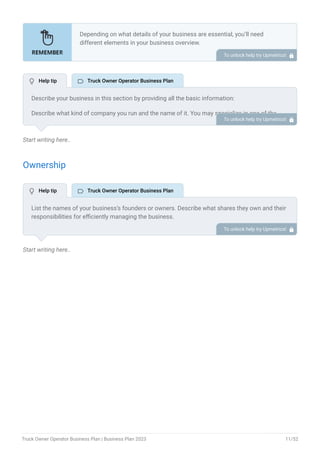
The company description should then explain the legal and organizational structure, location or service area, ownership, history where relevant, mission, and operating scope. For an owner-operator, this section should distinguish the owner’s strategic responsibilities from routine operating duties. For example, the owner might manage customer relationships, purchasing, financial oversight, and business development while a contractor, dispatcher, technician, or administrative provider handles defined parts of the workflow.
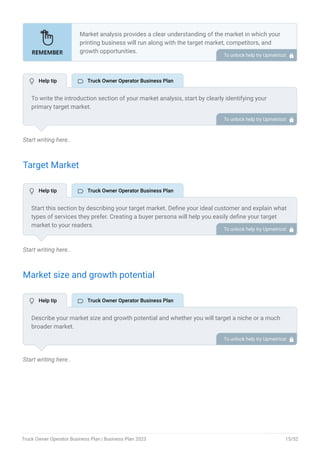
The market section should explain who buys the service, what problem they need solved, how they currently solve it, what alternatives exist, and why the proposed operation can compete. Market research should support assumptions instead of being included simply to make the document appear substantial. A good market section therefore connects customer needs directly to service design, pricing, capacity, marketing channels, and operational priorities.

Designing the operations section
The operations section is where an abstract business concept becomes a repeatable process. Start by mapping the customer journey from initial inquiry or order through fulfillment, payment, follow-up, and recordkeeping. Each major step should identify the responsible role, required input, expected output, timing, quality standard, and possible exception. This creates an operating model that can later become a standard procedure, checklist, training reference, or management dashboard.
Resource planning should cover both physical and nonphysical requirements. Depending on the business, resources can include equipment, vehicles, facilities, inventory, software systems, suppliers, contractors, insurance, professional services, communications, working capital, and specialized knowledge. The purpose is not to list everything imaginable but to identify resources that materially affect the ability to deliver the promised service.
Capacity should receive particular attention. A business may forecast a certain level of sales, but the operational plan needs to demonstrate that the company can actually fulfill that volume. Capacity may depend on labor hours, machine availability, vehicle utilization, facility space, supplier lead times, appointment slots, or management attention. If sales growth would exceed current capacity, the plan should identify the trigger for hiring, outsourcing, acquiring equipment, extending hours, or changing the process.

Turning strategy into measurable operating objectives
Good operating objectives should be specific enough to guide decisions. Instead of writing “improve efficiency,” an operator could define a target such as reducing average processing time, increasing on-time completion, lowering avoidable rework, improving equipment utilization, or reducing the time between completed work and collected payment. The exact metric should depend on the business model and should be measurable using information the business can realistically collect.
Key performance indicators should connect directly to the economics of the operation. Revenue alone rarely explains why performance changes. A service business may also monitor lead conversion, average transaction value, utilization, labor cost per unit, gross margin, repeat purchase rate, receivables aging, cancellation rate, or customer response time. A transportation operator might additionally track loaded miles, empty miles, fuel consumption, maintenance costs, revenue per mile, and equipment downtime.
Targets should also have review dates. An operational plan is not useful if its assumptions remain unchanged while the business evolves. Asana’s current guidance on operational planning recommends defining objectives, allocating resources, establishing KPIs, communicating the plan, and reviewing it as circumstances change; it also notes that quarterly review is a practical minimum for many organizations, with faster-moving operations potentially benefiting from more frequent checks. :contentReference[oaicite:2]{index=2}
Choosing between document and spreadsheet formats
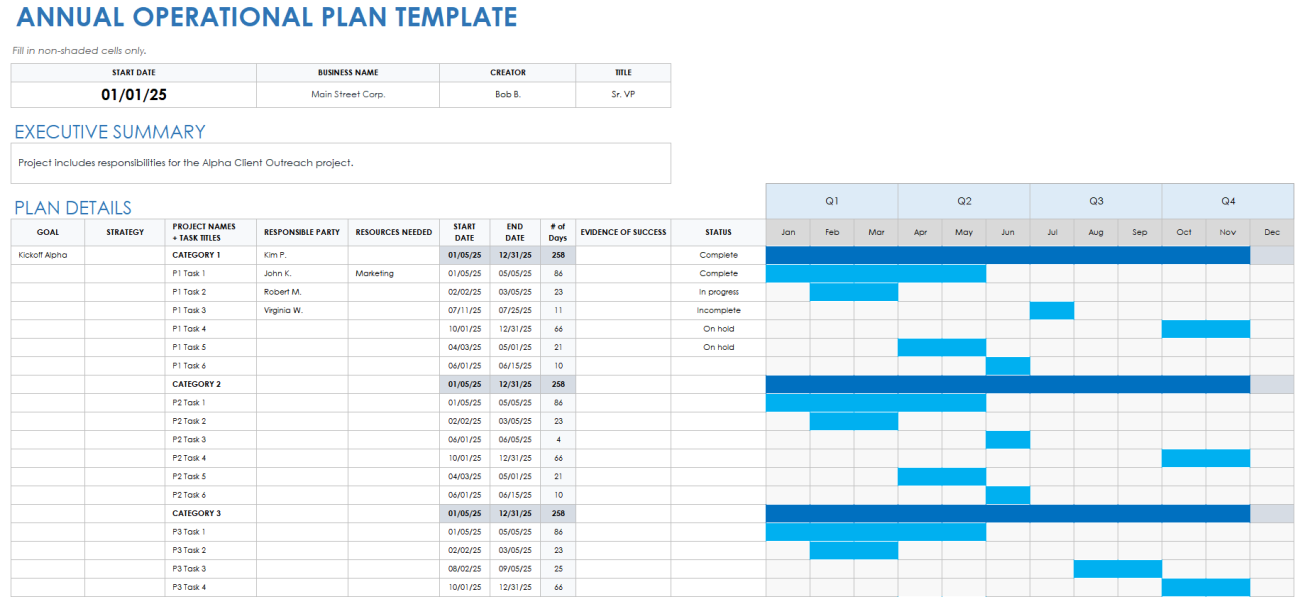
The best format depends on what the document needs to accomplish. A narrative document is usually better for explaining the business concept, market opportunity, operating philosophy, management structure, and strategic assumptions. A spreadsheet is stronger for financial projections, schedules, capacity calculations, resource planning, KPI tracking, and scenario analysis. In practice, many effective plans use both formats rather than forcing every type of information into one file.
For readers searching for an operator business plan template pdf, a fixed-layout document can be useful when the goal is review, printing, or formal presentation. It is less convenient for frequent calculations and revisions. A structured Word-style document is better when the operator needs to write explanations, while a spreadsheet is more suitable when assumptions must be changed repeatedly and calculations need to update consistently.
The search for an operator business plan template excel often reflects a need for financial or operational modeling rather than prose alone. Excel-style planning works particularly well for startup costs, monthly revenue, variable expenses, fixed expenses, cash flow, break-even analysis, equipment schedules, and scenario comparisons. Smartsheet’s business-plan resources likewise distinguish narrative planning from financial templates and provide formats intended for financial statements, projections, and planning workflows. :contentReference[oaicite:3]{index=3}

How to structure financial assumptions
The financial section should begin with assumptions rather than unsupported outcomes. Identify how the business expects to generate revenue, what customers pay, how often they buy, and what operational capacity supports those sales. Then estimate direct costs and operating expenses. This approach allows the financial model to show the relationship between activity and money instead of presenting a collection of isolated figures.
For example, suppose a hypothetical service operator expects 80 billable jobs per month at an average realized price of $250. The resulting monthly revenue assumption would be $20,000 before considering cancellations, discounts, taxes, or other adjustments. If each job also requires a variable direct cost of $90, that cost driver should be visible. The example is hypothetical, but the principle is important: revenue and cost projections should be built from operational drivers that can be checked against actual performance.
Cash flow deserves separate attention because accounting profit and cash availability are not identical. A profitable operation can still experience pressure when customers pay slowly, inventory must be purchased before sales occur, equipment requires a large upfront payment, or debt repayments fall due before expected receipts. A useful plan therefore considers the timing of inflows and outflows, not merely annual profit.
Using an owner-operator structure effectively
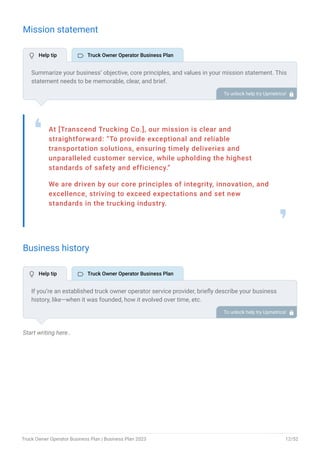
An owner operator business plan template should reflect the reality that the owner may initially perform several functions. A transportation owner-operator, for example, may simultaneously handle business development, dispatch decisions, equipment oversight, customer communication, bookkeeping coordination, compliance administration, and service delivery. The plan should identify these roles clearly instead of assuming that a large management team exists from the beginning.
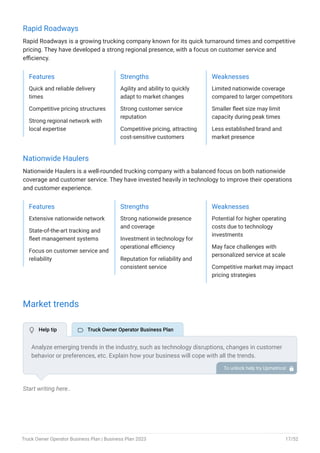
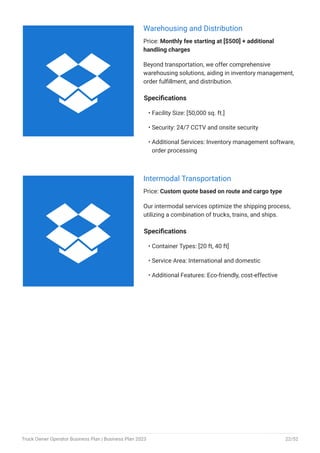
For a trucking or logistics operation, the plan can be organized around service type, target customer, equipment, route or service area, dispatch process, maintenance, insurance, compliance responsibilities, fuel assumptions, driver arrangements where applicable, and payment cycles. A published truck owner-operator business-plan example illustrates a structure that includes market analysis, services, sales and marketing, operations, management, financial statements, break-even analysis, financing needs, and supporting material. :contentReference[oaicite:4]{index=4}
One of the most useful features of this structure is that it exposes operational constraints before money is committed. If the financial model assumes a certain volume of completed work, the operations section should explain how that volume will be generated and fulfilled. If equipment is financed, the financial section should reflect the associated payment burden. If maintenance downtime can reduce capacity, the plan should show how that risk is managed rather than assuming uninterrupted availability.
Building the executive summary from the operating model
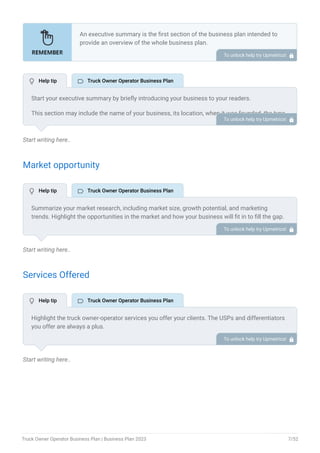
The executive summary should explain the business in a way that makes the rest of the plan easy to understand. Start with the customer problem, the service offered, the target market, and the reason the business can compete. Then summarize the operating model and financial direction. If funding is being considered, explain the purpose of the capital and the operational milestones it is intended to support.
A strong summary avoids vague statements such as “the company will become the market leader.” Instead, it identifies concrete objectives and explains how the operation intends to reach them. If a goal depends on increasing capacity, expanding a service territory, adding equipment, improving conversion, or securing recurring contracts, the summary should point toward those specific mechanisms.
Current business-plan guidance also supports treating the executive summary as an overview rather than a substitute for evidence. A business plan template can prompt the writer to cover market opportunity, products or services, marketing, financial highlights, and other key areas, but the underlying details still need to be developed and supported elsewhere in the document. :contentReference[oaicite:5]{index=5}
Market analysis that operators can actually use
A market analysis should help an operator make decisions, not simply describe an industry. Define the target customer narrowly enough to understand buying behavior. For example, a commercial service operator might distinguish recurring contract customers from one-time customers because the two groups can have very different acquisition costs, scheduling patterns, service expectations, and payment terms.
Competitive analysis should identify substitutes as well as direct competitors. A customer may choose another specialist, a larger provider, an internal team, a lower-cost alternative, or simply continue with an existing process. Understanding those alternatives helps the operator identify a genuine competitive advantage. The advantage could be faster response, geographic coverage, specialized equipment, better scheduling, transparent pricing, reliability, or a narrower niche rather than a generic claim of superior service.
The market section should also identify risks that could affect operations. Changes in customer demand, supplier availability, technology, fuel or material costs, labor availability, seasonal patterns, or regulatory conditions can alter the assumptions behind a business plan. These risks should feed directly into contingency planning and scenario analysis.
Defining company ownership and responsibilities
The company overview should make ownership and decision rights easy to understand. A small operation does not need a complicated organizational chart, but it should still identify who makes decisions about pricing, purchasing, customer acceptance, quality, finance, scheduling, supplier relationships, and risk. Ambiguous ownership of decisions often becomes an operational problem as soon as workload increases.
When several people or external providers participate in the operation, define their boundaries. An accountant may prepare reports without making operating decisions. A dispatcher may schedule work without changing pricing authority. A contractor may perform a defined service without being responsible for the entire customer relationship. These distinctions make the plan more realistic and can later support agreements, procedures, training, and performance reviews.
The same logic applies to succession and growth. If the owner is the only person who knows how a critical process works, the business carries key-person risk. Documenting recurring procedures and decision rules in the plan can make delegation easier and reduce dependence on informal knowledge.
Writing mission, history, and future goals
The mission statement should describe what the business is trying to accomplish for its customers and how it intends to operate. It does not need to be a slogan. A practical mission can identify the service provided, the customer served, and the operating principles that matter most, such as reliability, safety, responsiveness, quality, or specialization.
Business history is useful when it explains why the current operating model exists. Include meaningful milestones, previous experience, changes in service scope, or lessons that influenced the current strategy. A new business can instead explain the experience and observations that led to its concept, while clearly separating actual history from future plans.
Future goals should be measurable and time-bound. A goal such as “expand the business” becomes more useful when expressed through a specific service area, capacity level, customer segment, revenue objective, staffing milestone, or operational improvement. Goals should also have dependencies so the operator knows what must happen first.
Connecting products and services to operations
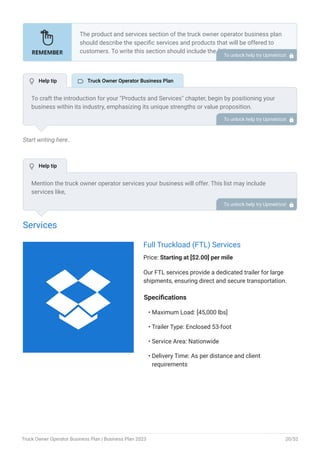
The products or services section should describe what the customer actually receives. Include the scope, deliverables, pricing logic, service boundaries, turnaround expectations, quality standards, and support arrangements where relevant. The goal is to make the offer specific enough that the operations section can show exactly how it will be delivered.
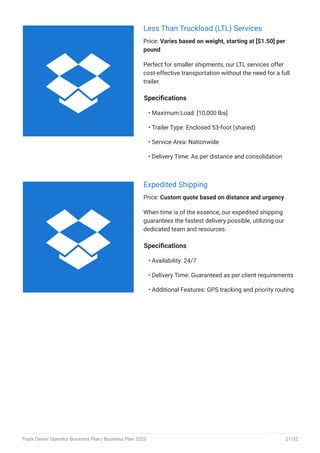
Different service levels should be separated when they require different resources. For example, standard service might use normal scheduling while expedited service requires reserved capacity. A basic package might require limited labor, while a premium package could require specialized equipment or additional quality checks. These differences should appear in both pricing assumptions and operational planning.
A useful test is to ask whether another competent person could read the service description and understand what must be delivered. If the answer is no, the description is probably too vague. The more precisely the offer is defined, the easier it becomes to calculate capacity, cost, staffing, scheduling, and profitability.
Operational examples for an owner-operator business
Consider a hypothetical mobile maintenance operator. The workflow might begin with a customer inquiry, followed by service qualification, quotation, scheduling, preparation of parts and tools, travel, service execution, quality verification, invoicing, payment follow-up, and customer feedback. Each step creates an operational requirement. The business needs a method for scheduling, a way to verify inventory, a travel-cost assumption, a quality checklist, and a process for collecting payment.
Now consider a hypothetical logistics operator. The process could begin with a customer request, shipment qualification, pricing, scheduling, equipment assignment, pickup, transport, delivery confirmation, invoicing, and reconciliation. If the business promises reliable delivery, the operating plan needs procedures for route planning, equipment readiness, communication, exceptions, maintenance, and documentation.
These examples demonstrate why a template should not dictate the business model. The framework can be standardized, but the operational content must come from the specific business. Templates are useful for ensuring that major questions are not overlooked; they are not substitutes for business-specific assumptions or evidence.

Market size, competition, and strategic positioning
Market size should be handled carefully because broad industry estimates can create unrealistic expectations. A better approach is to distinguish the total theoretical market from the portion the business can realistically serve. Consider geography, customer type, capacity, pricing, operating hours, qualifications, and current competitive position when estimating the reachable market.
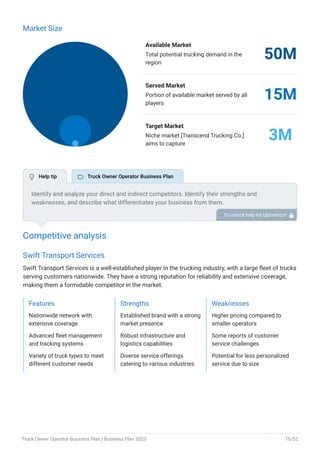
Competitive comparisons should focus on attributes that customers actually value. A competitor matrix can compare service scope, response time, geographic reach, price positioning, capacity, specialization, customer support, and operational reliability. The purpose is not to criticize competitors but to identify where the proposed operation has a credible reason to win.
The strategic position should then flow into the operating model. If the advantage is rapid response, scheduling capacity becomes critical. If the advantage is low cost, procurement and process efficiency become critical. If the advantage is specialization, training, equipment, compliance, and quality assurance may become the central operating priorities.
Using competitive analysis without inventing evidence
A competitor section should be based on information that can be verified or clearly identified as an assumption. Public pricing pages, service descriptions, published locations, customer-facing materials, industry directories, and direct research can inform the analysis. If a fact cannot be confirmed, label it as an assumption rather than presenting it as established information.
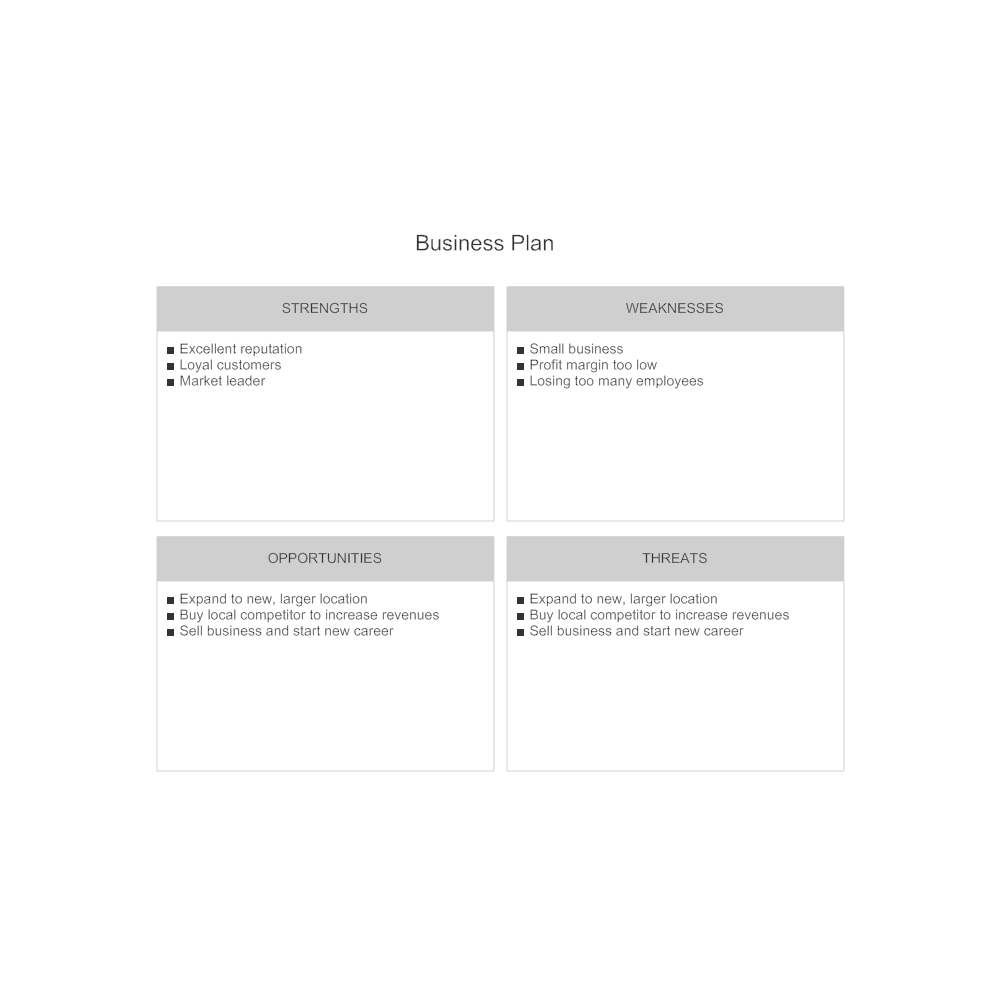
SWOT analysis can help organize the findings, but it should not replace deeper analysis. A strength matters only when it supports customer value or operational performance. A weakness matters when it creates a real constraint. An opportunity should identify a plausible path to additional demand or better economics, while a threat should describe a condition that could materially affect the business.
The strongest competitive section connects each observation to an action. If a competitor has broader geographic coverage, the operator may focus on a defined local niche. If a competitor competes primarily on price, the operator may emphasize service reliability or specialization. If competitors offer similar services, process quality and customer experience may become more important differentiators.
Pricing and sales strategy
Pricing should reflect both customer value and operating economics. Calculate the costs required to deliver the service, then consider desired margin, competitive positioning, customer willingness to pay, payment terms, and capacity constraints. A price that generates sales but does not cover the full economic cost of delivery is not a sustainable operating strategy.
Sales strategy should explain how prospects become customers. Depending on the business, this may involve referrals, direct outreach, partnerships, search visibility, repeat business, distributors, industry relationships, or other channels. The plan should identify which channels will be tested first and what evidence will determine whether a channel deserves additional resources.
Retention should also be treated as an operating issue. Repeat customers may require different service standards, communication routines, account reviews, scheduling preferences, or support processes. The business plan should describe how customer information is captured and how recurring relationships are maintained without creating excessive administrative work.
Sales and marketing should support the operating capacity
Marketing should never be planned independently of operational capacity. If a campaign could generate more demand than the company can fulfill, the result may be slower service, customer dissatisfaction, overtime, rushed work, or unnecessary costs. Before increasing demand, determine how much additional work the operation can absorb and what capacity trigger would require an operational change.
Marketing objectives should therefore be connected to operational metrics. If the goal is to increase qualified leads, monitor lead volume and conversion. If the goal is recurring contracts, monitor proposal-to-contract conversion and retention. If the goal is geographic expansion, measure demand and service economics within the new territory before committing to permanent resources.
A template can make this relationship visible by placing marketing assumptions next to capacity and financial assumptions. That prevents a common planning error in which revenue is projected independently of the people, equipment, suppliers, or working capital needed to produce it.
Managing service variations and capacity
When a business offers multiple service categories, each should have its own operational assumptions. A standard service might have predictable labor and material requirements, while a specialized service could require additional equipment, training, inspection, or coordination. Separating these assumptions makes pricing and capacity planning more accurate.
Service-level commitments should also be realistic. A promise of same-day response requires sufficient availability, while a promise of scheduled delivery requires reliable scheduling and contingency capacity. The plan should identify the minimum resources necessary to meet the promised standard and what happens when those resources are unavailable.
This is especially important for owner-operators because a single unavailable vehicle, machine, technician, or decision-maker can materially reduce capacity. A practical plan should therefore identify backup arrangements, preventive maintenance, supplier alternatives, or scheduling buffers where those measures make economic sense.
Supply chain, facilities, and equipment
Suppliers should be evaluated based on more than purchase price. Lead time, minimum order quantities, reliability, quality, payment terms, geographic location, and replacement options can all affect operational performance. A critical supplier with no practical substitute represents a business risk that should appear in the plan.
Facilities should be described according to how they support the operating process. Consider storage, customer access, equipment movement, safety, utilities, workspace, dispatch or administrative needs, and expansion capacity. The plan should avoid claiming that a facility can support a particular volume unless that capacity has been reasonably established.
Equipment planning should include acquisition cost, useful operating capacity, maintenance, replacement timing, downtime risk, insurance or other recurring costs, and financing where applicable. Equipment that appears inexpensive at purchase can become expensive if it has high maintenance needs or prevents the business from serving customers reliably.
Quality control and customer experience
Quality should be translated into observable standards. Instead of saying that the business provides excellent service, define what excellent service means operationally. It might mean a particular response window, inspection procedure, delivery confirmation, error rate, documentation standard, or follow-up process.
Quality checks should occur at points where errors can still be corrected economically. For example, verifying an order before fulfillment is usually more useful than discovering an error after delivery. Similarly, inspecting equipment before service begins can prevent avoidable interruptions during customer work.
Customer feedback should feed into operational improvement. Repeated complaints about scheduling may indicate a capacity problem, while complaints about inconsistent service may indicate a training or process-control problem. The business plan should show how feedback is collected, reviewed, and converted into specific corrective actions.
Practical Solution
Start by creating one master planning document with nine working areas: business purpose, customer and market, services, sales and marketing, operations, management, financial assumptions, risks, and supporting evidence. Do not attempt to complete every section at once. Begin with the actual operating workflow, because it provides the assumptions needed for staffing, equipment, capacity, pricing, and financial projections. Then document the customer and market logic that explains why the workflow should generate demand.
Next, create a simple operating-control sheet. For every major activity, record the responsible role, frequency, required resource, expected output, performance measure, and escalation point. For financial planning, connect revenue to measurable operating drivers rather than entering a single annual estimate. If the business sells units, model units and price. If it sells hours, model billable hours and realized rate. If it sells routes, contracts, projects, or recurring services, use the corresponding operational driver.
Finally, review the plan on a regular operating cycle. Compare actual sales, costs, capacity, service quality, cash position, and major risks against the assumptions in the document. When an assumption changes, update the affected operational and financial sections rather than leaving contradictory figures in place. This turns the template into a living management system rather than a one-time planning exercise.
For someone searching for an operator business plan template word, the most important principle is to treat the document format as a container rather than the strategy itself. The same operating logic can be transferred into a Word document, spreadsheet, printable format, or collaborative document. The content remains the priority: clear assumptions, responsibilities, processes, metrics, financial logic, and evidence.
Those searching for an operator business plan template google docs are often looking for a format that supports shared editing and review. That can be useful when an owner works with an accountant, business partner, manager, advisor, or lender. Regardless of the editing environment, version control matters. Keep one authoritative version, record important changes, and make sure financial assumptions match the narrative sections.
Searches for an operator business plan template free download indicate a strong desire for a ready-made starting point, but the quality of the final plan still depends on customization. A blank template can save formatting time while leaving the difficult work untouched: researching customers, defining capacity, validating costs, identifying risks, and building realistic financial assumptions. Current template libraries from Smartsheet, SCORE, and other business-planning publishers demonstrate how varied these structures can be, which is another reason to adapt the framework to the actual business. :contentReference[oaicite:6]{index=6}
When a business operating plan is better than a traditional business plan
A traditional business plan is broad. It explains the business model, market, competitive position, management, strategy, and financial outlook. A business operating plan template is narrower and more execution-focused. It is particularly useful after strategic goals have been established and the organization needs to translate those goals into activities, owners, timelines, resources, and performance measures.
A business operations plan template should therefore answer the “how” questions. How will the service be delivered? How will work be scheduled? How will quality be checked? How will inventory or equipment be managed? How will suppliers be monitored? How will performance be measured? How will exceptions be handled? How will the company respond when demand exceeds capacity?
The two documents can work together. The business plan explains why the company should pursue a particular direction, while the operating plan explains how the organization will execute it. Keeping the distinction clear prevents the business plan from becoming overloaded with daily details while ensuring that strategy does not remain disconnected from execution.
Operation plan in business plan example: how the pieces connect
An operation plan in business plan example might describe a service company that receives customer requests, qualifies the work, schedules resources, performs the service, checks quality, invoices the customer, and follows up. The example becomes useful when each stage is linked to a responsible role, expected timing, resource requirement, and cost assumption. This demonstrates how operational activity supports the financial forecast rather than existing as a disconnected narrative.
An operational plan in business plan example can also show the relationship between strategic objectives and daily actions. Suppose a hypothetical company wants to increase recurring customers. The operational response might include standardized onboarding, scheduled account reviews, service-quality checks, renewal reminders, and a defined process for resolving complaints. The financial model can then estimate the effect of recurring customers using clearly stated assumptions.
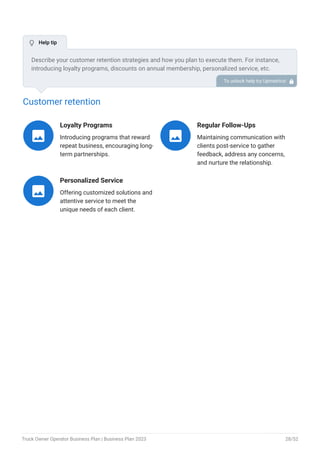
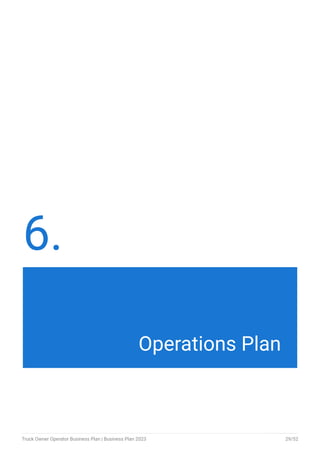
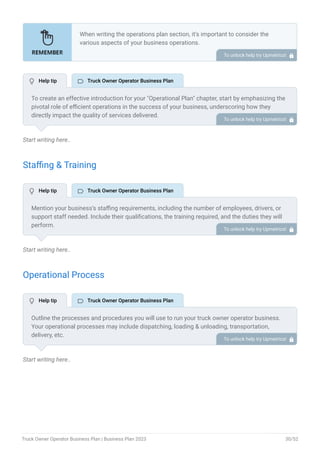
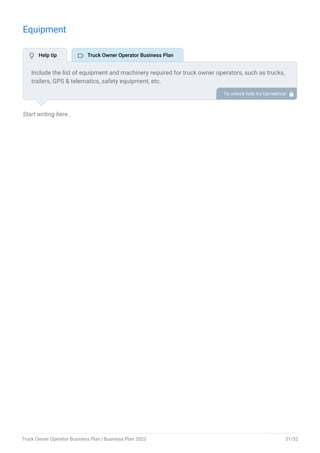
Published business-plan examples commonly include operations as a distinct section alongside market analysis, products and services, marketing, management, and financial planning. A truck owner-operator example, for instance, separates operational processes, staffing and training, equipment, management, and financial statements into connected parts of the plan. :contentReference[oaicite:7]{index=7}
Financial planning, break-even thinking, and cash control
The financial section should translate the operating model into numbers. Include startup costs where relevant, recurring fixed costs, variable costs, revenue assumptions, projected profit and loss, cash flow, and balance-sheet considerations where appropriate. The goal is not to make a forecast appear precise. The goal is to make the assumptions transparent enough that management can challenge and update them.
Break-even analysis is especially helpful for operators because it shows the approximate level of activity required to cover the relevant costs. The calculation depends on the business model, but the basic concept is to compare contribution from each unit of activity with fixed operating costs. A service business might measure the required number of billable jobs, while a transportation business might examine required loads, miles, or contracts.
Cash controls should include invoicing discipline, payment terms, collection follow-up, reserve planning, and awareness of large upcoming expenses. A plan that shows strong projected profit but leaves cash timing unexplained is incomplete. The operating and financial sections should therefore be reviewed together whenever pricing, capacity, supplier terms, staffing, or equipment assumptions change.
Common mistakes to avoid
The first mistake is treating the template as the finished plan. A template can provide headings and prompts, but it cannot know the actual customer, operating capacity, supplier economics, cost structure, or competitive position. Replace generic language with business-specific evidence and clearly mark hypothetical assumptions.
The second mistake is separating the numbers from the operations. If the financial model assumes a certain volume of sales, the operations section should demonstrate how that volume can be delivered. If staffing costs increase, the plan should explain what additional capacity or capability the spending provides. If equipment financing is added, the cash-flow model should reflect the repayment schedule.
The third mistake is making the plan too static. Markets, prices, staffing, suppliers, and operating constraints change. A useful plan should be reviewed and revised when important assumptions change. The purpose is not to preserve the original forecast; it is to maintain a realistic picture of how the business works now and what management intends to do next.
How to make the template easier to maintain
Keep the structure modular. Store narrative sections separately from calculations where possible, but make their assumptions easy to reconcile. Use consistent terminology for customers, services, units, costs, departments, and operating periods. If the same metric appears in several sections, it should have the same definition and time period.
Create an assumptions register for figures that materially affect the plan. Record the assumption, source or rationale, date reviewed, and what would cause it to change. This is particularly valuable for pricing, customer volume, labor costs, fuel or material costs, supplier lead times, capacity, and financing assumptions.
Use scenario planning when uncertainty is significant. A base scenario can represent the current expectation, while a downside scenario can test lower demand, higher costs, slower collections, or unexpected downtime. An upside scenario can test stronger demand and the resources required to fulfill it. Scenario planning turns uncertainty into a management question instead of leaving it as an unexplained risk.
Reference Examples
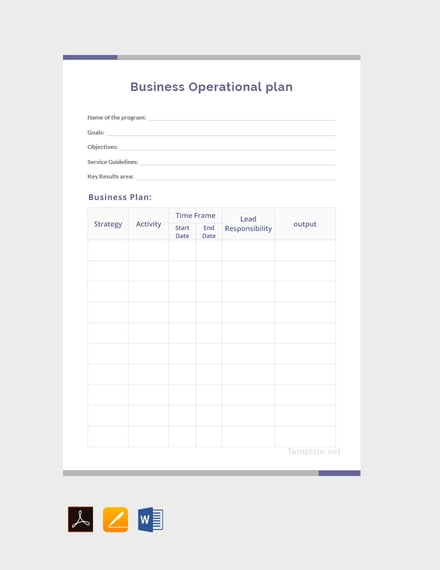
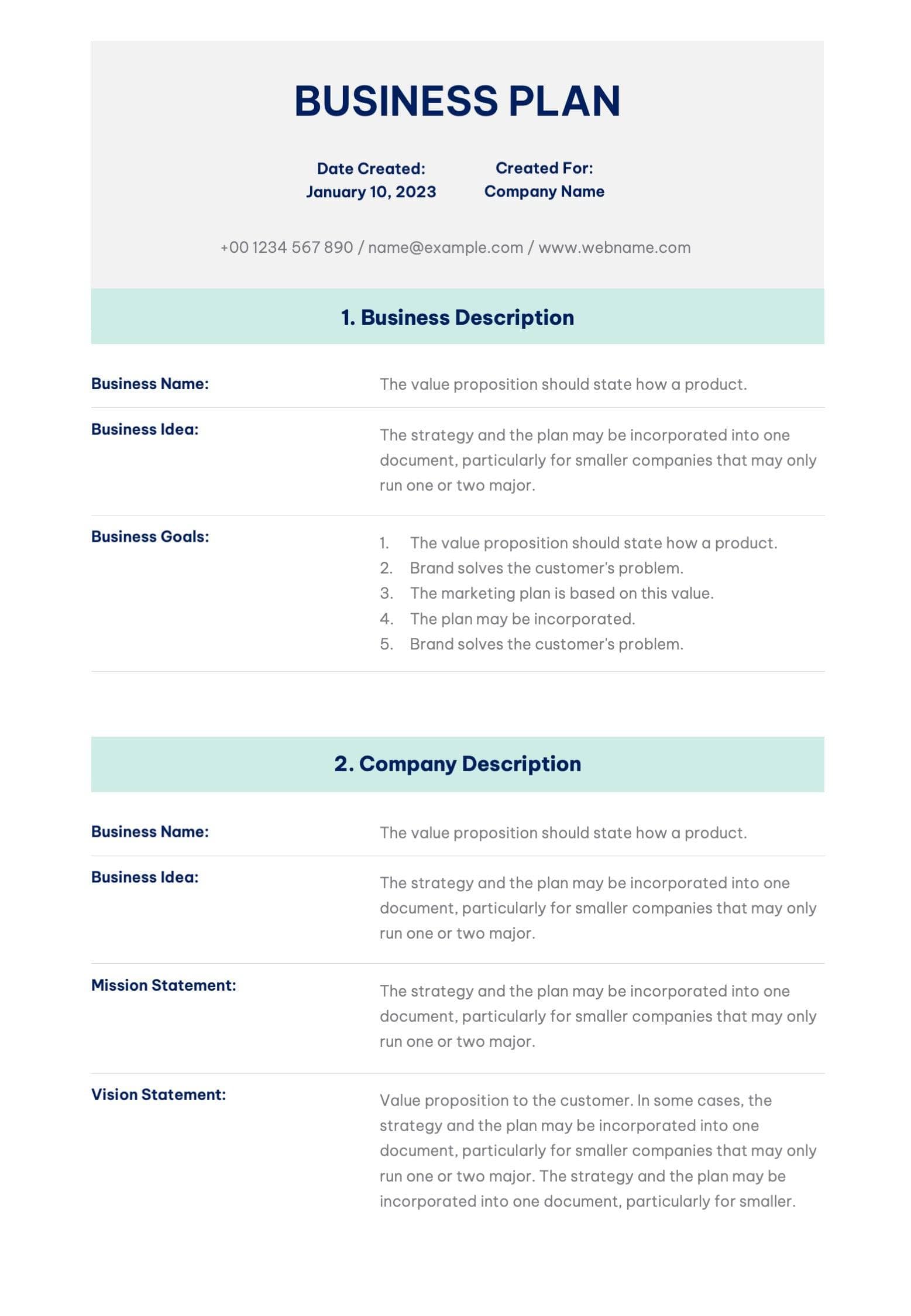
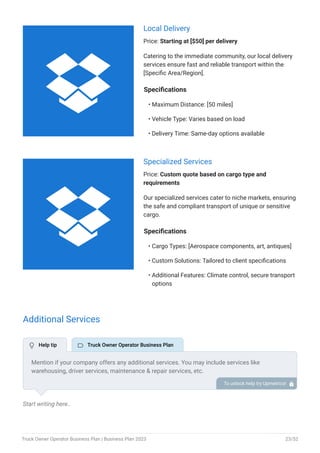
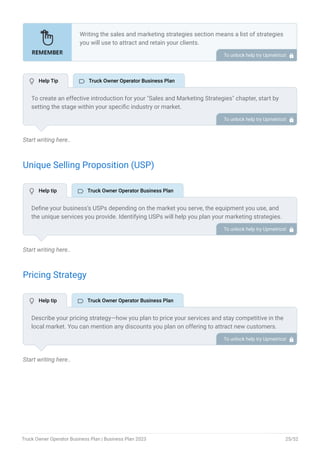
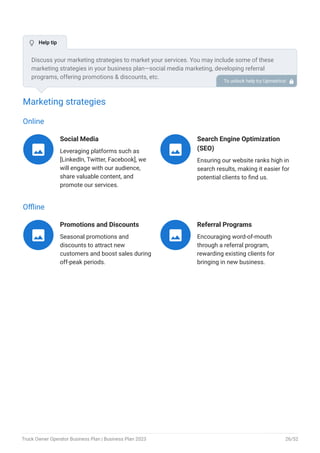
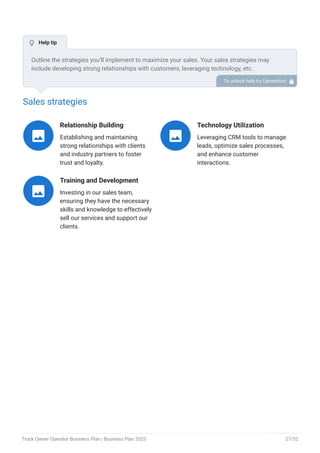
The following visual references show how an operator-focused business plan can be organized across narrative sections, market analysis, services, operations, and financial planning. The examples are particularly useful because they demonstrate that a practical plan is not simply a polished cover page followed by generic prose. Strong structures separate the major decision areas and give each section a specific purpose. For an operator business plan Template, this helps the reader see where operating assumptions belong, how services connect to resources, and where financial consequences should be documented.
These references can also help when evaluating the structure of an existing operator business plan Template. Look for clear sequencing, readable section boundaries, operational prompts, financial worksheets, and supporting material. A useful visual example should help you recognize what information is missing from your own plan without encouraging you to copy unsupported figures or generic claims. The best reference is therefore the one that improves your thinking about your own customers, capacity, resources, risks, responsibilities, and financial assumptions.
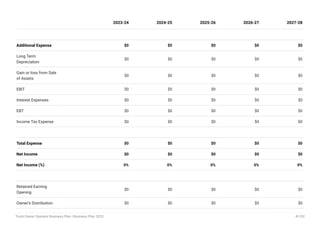
Projected Expenses and Net Income
Source: SlideShare
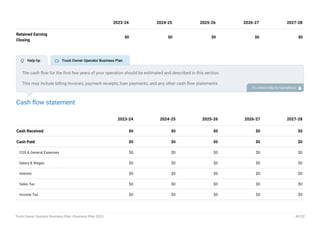
Cash Flow Statement
Source: SlideShare
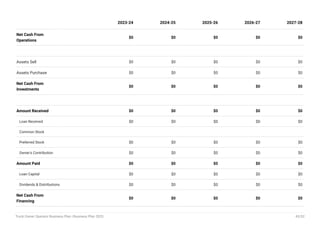
Net Cash From Operations, Investments, and Financing
Source: SlideShare
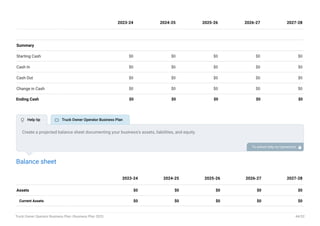
Cash Summary and Balance Sheet
Source: SlideShare
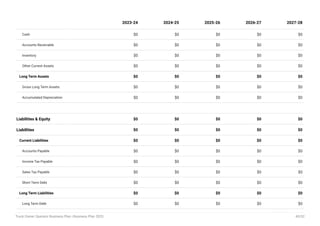
Balance Sheet
Source: SlideShare
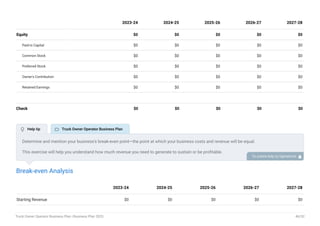
Break-even Analysis
Source: SlideShare
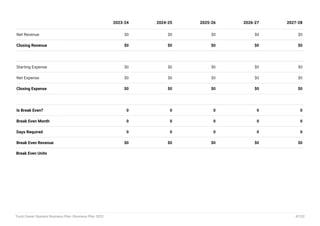
Break-even Revenue and Units
Source: SlideShare
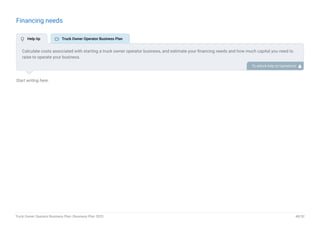
Financing Needs
Source: SlideShare

Appendix
Source: SlideShare

Appendix Supporting Information
Source: SlideShare
