A well-prepared hawaii medical records request Template can make the process of obtaining health information much easier, particularly when a patient needs records from a hospital, physician, clinic, imaging center, or health system in Hawaiʻi. The most useful request identifies the patient, the organization holding the records, the exact information sought, the relevant dates of service, the intended recipient, and the preferred method of receiving the records. A clear request also reduces uncertainty about whether the patient is asking for access to their own records or authorizing disclosure to another person or organization.
Federal HIPAA rules generally give an individual a right to inspect and receive copies of protected health information maintained in designated record sets, subject to limited exceptions. HHS explains that these records can include medical records, billing information, laboratory results, X-rays, insurance information, and other information used to make decisions about the individual. A provider may require a written request, and a request directed to a third party should clearly identify the person or organization designated to receive the information.
Hawaiʻi requests also need practical attention to the policies of the particular record holder. A hospital system may use its own patient-access form, while a physician office may accept a written request or authorization. Some organizations distinguish between a request made by the patient and an authorization allowing disclosure to another recipient. The safest approach is therefore to use a provider’s current procedure when one exists, while making sure the underlying request contains enough information to identify the patient and records accurately.
What a Hawaiʻi medical records request should accomplish
The central purpose of a medical records request is identification. A records department must be able to determine whose information is being requested, which organization or department maintains it, and what material should be produced. A request that simply says “send my medical records” may leave important questions unanswered. Adding the patient’s full name, date of birth, medical record number when known, previous name if relevant, address, telephone number, and other identifying information can help the custodian match the request to the correct chart.
The second purpose is scope. Medical records can contain many different categories of information, including office notes, discharge summaries, laboratory results, pathology reports, imaging reports, radiology images, medication histories, immunization records, operative reports, consultation notes, and billing information. A patient who needs a complete chart should say so. Someone who only needs laboratory results from a particular period should state that narrower request instead. Specificity helps prevent both underproduction and unnecessary disclosure.
The third purpose is delivery. The requester should state whether the records should be sent to the patient, another healthcare provider, an attorney, an insurer, or another authorized recipient. The recipient’s name and contact information should be complete. If an electronic format is requested, the requester can state the preferred format while recognizing that the record holder may use a different format when necessary or when the requested format is not readily producible.
Request for access versus authorization to disclose
One of the most important distinctions in a request for medical records template is whether the patient wants access to their own information or wants a provider to disclose information to someone else. A patient-access request is directed toward obtaining the patient’s own records. An authorization for disclosure generally tells a covered entity that it may release specified protected health information to a named third party. The two concepts overlap, but they are not always handled through the same form.
HHS states that individuals generally have a HIPAA right of access to protected health information in designated record sets. That right can encompass much more than a physician’s progress notes. Depending on the record set, it can include laboratory reports, diagnostic images, billing records, claims information, and other health information used by a covered entity. There are limited exceptions, including certain psychotherapy notes and other specially protected material.
When the patient directs a provider to send records to another person or organization, the written request should clearly identify that recipient and where the information should be sent. This is especially important when an attorney, insurer, family member, new physician, or other third party is involved. A request should not assume that the recipient’s identity is obvious from the surrounding circumstances.

Key sections to include in a Hawaii medical records request
A strong medical record request template hipaa structure starts with patient identification. Include the patient’s legal name, date of birth, current address, telephone number, and medical record number if available. If the patient has received care under a former name, including that name can be useful. A request made by a parent, guardian, personal representative, or other authorized person should identify that relationship and, when appropriate, describe or document the authority to act for the patient.
The next section should identify the record holder. State the healthcare provider, hospital, clinic, medical group, department, or health system from which the records are requested. If the patient received care at multiple locations, list each relevant facility rather than assuming one department will automatically search every location. Include approximate treatment dates and, when known, the name of the physician or specialty involved.
The records section should be precise enough to prevent ambiguity. For example, a request could identify “complete medical records for treatment from January 1, 2024 through December 31, 2025,” or it could specify “laboratory results, radiology reports, and imaging studies for the emergency department encounter on a stated date.” A narrowly defined request can be useful when only selected documents are needed, while a complete-record request may be more appropriate for continuity of care or a comprehensive legal review.
Patient identification
Patient identifiers should be accurate and consistent with the provider’s existing records. The full legal name and date of birth are usually the most important starting points. A medical record number can further distinguish one patient from another when the organization uses one. Address and telephone information can provide additional verification, but a requester should avoid putting unnecessary sensitive information into a communication channel unless the provider specifically asks for it.
If the request is made by someone other than the patient, the request should make that relationship clear. A parent requesting a child’s records, a legal guardian acting for an individual, or another personal representative may need to establish authority under the circumstances. The record holder’s own instructions should be followed because requirements can differ depending on the patient, the type of record, and the requester.
Identity verification is particularly important because medical records contain highly sensitive information. A request that omits identifying details may be delayed while the record department tries to determine which chart is involved. At the same time, a requester should not automatically send extra identity documents unless they are required or reasonably requested by the custodian.
Records and dates of service
Dates of service are one of the simplest ways to make a request more useful. If the patient knows the exact encounter date, include it. If the request concerns an extended period, provide the beginning and ending dates. If the requester wants the complete record without limiting the period, say that clearly. Avoid relying on vague wording such as “recent records” when a precise period can be provided.
The requester should also distinguish between records and images when relevant. A radiology report is not necessarily the same thing as the underlying diagnostic image. Similarly, a laboratory result may be different from a broader laboratory record, and an itemized bill is different from a clinical chart. If the intended use requires the underlying images, reports, or billing documentation, list those items specifically.
For continuity of care, a focused request may be sufficient. A new specialist may need recent consultation notes, medication information, laboratory results, imaging reports, and relevant diagnostic images rather than an unrelated historical chart. For legal review, insurance matters, disability documentation, or a comprehensive medical history, a broader request may be more appropriate.
Hawaii medical records request template considerations for Oahu
People searching for a hawaii medical records request template oahu should first identify the organization that actually maintains the records. Oʻahu has large integrated health systems, independent physician practices, specialty clinics, imaging facilities, and other custodians. There is not necessarily one universal form that works for every provider on the island. The appropriate procedure depends on the organization holding the information.
For a request involving an Oʻahu hospital, identify the facility and, when possible, the department responsible for Health Information Management or Release of Information. For a private practice, contact the office and ask how it accepts patient-access requests. If several organizations were involved in the same episode of care, consider whether separate requests are necessary. A hospital’s chart may not contain every record held by an outside physician, laboratory, or imaging center.
Oʻahu requests also illustrate why a generic template should be treated as a starting structure rather than an institutional form. A provider may have its own authorization language, preferred submission method, identity verification process, or patient portal workflow. The general request can help a patient understand what information to gather, but the provider’s current instructions should control the mechanics of submission.
Hawaii Pacific Health medical records requests
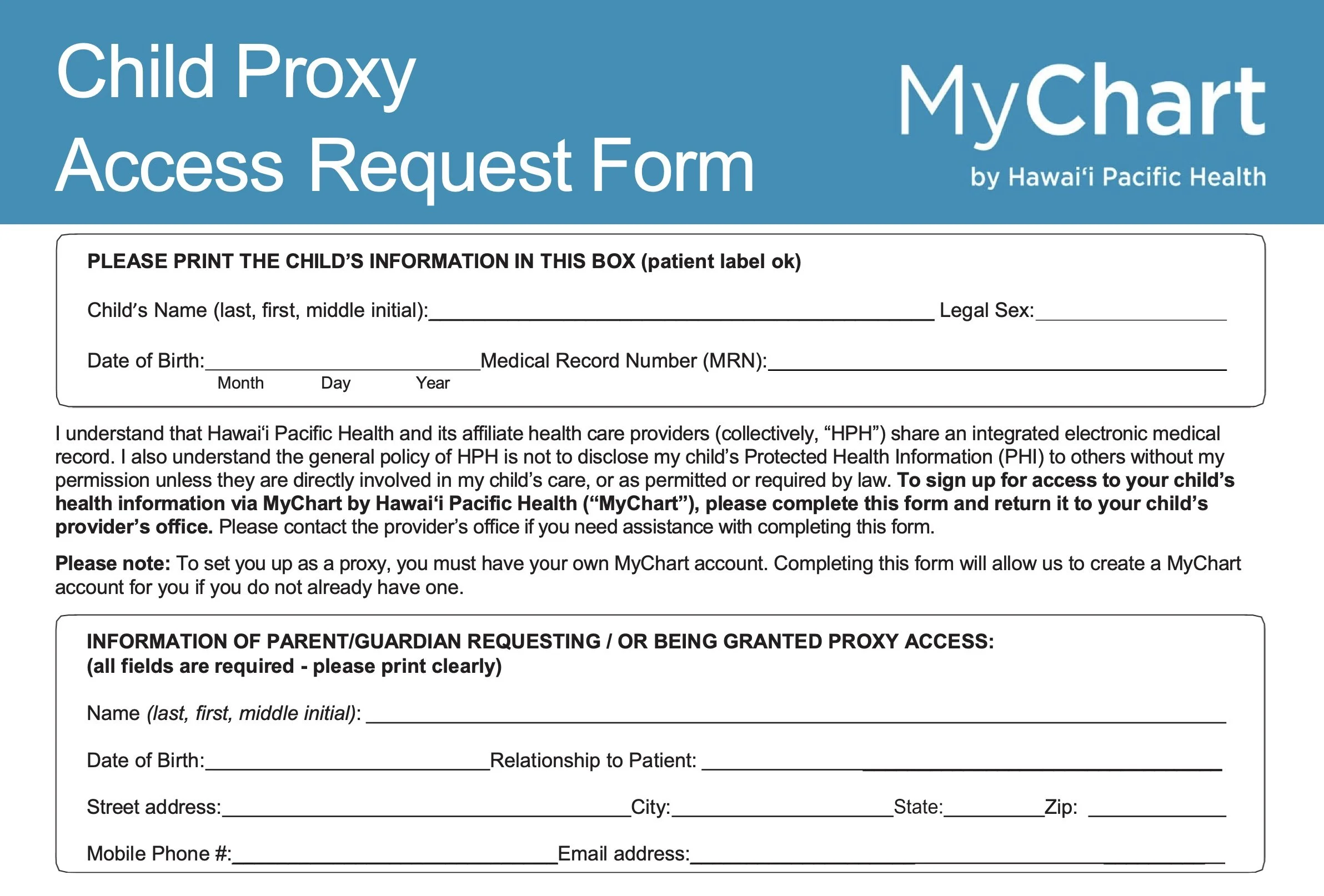
A search for hawaii pacific health medical records request often reflects a need to distinguish between records access and other patient-information services. Hawaiʻi Pacific Health provides several ways for patients to interact with their health information, including MyChart-related services and records-request information. Its published materials indicate that patients can use MyChart to submit a request for their medical record and receive a notification when a record release is available.
When dealing with hawaii pacific health medical records, the requester should identify the patient, specify what information is needed, and follow the current instructions provided by Hawaiʻi Pacific Health. If the request involves a child or proxy access, the process can be different from an adult requesting their own records. The distinction matters because authorization and access rights can depend on the patient’s age and the authority of the person making the request.
A practical request should therefore avoid assuming that one generic form applies to every Hawaiʻi Pacific Health situation. If the organization provides a patient-specific workflow, use that workflow. A general template is still useful for preparing the necessary details in advance, particularly dates of service, requested record categories, recipient information, and the patient’s identifying information.
Hawaii medical records request template Kaiser considerations
People searching for a hawaii medical records request template kaiser should use Kaiser Permanente Hawaiʻi’s current records instructions rather than relying solely on a generic form. Kaiser Hawaiʻi publishes a records and forms page that distinguishes between a basic health summary, detailed electronic medical-record requests, pharmacy records, and other record-related services. The organization also provides a patient request form and a patient access request form among its published materials.
Kaiser Hawaiʻi states that patients can request an electronic copy of detailed medical records and specify the date range, records requested, and party receiving the copy. Its current published information says to allow 10 to 15 business days for completion of a detailed electronic medical-record request. That timeframe is an organizational estimate for the described process, not a universal guarantee for every request.
A Kaiser request should therefore be specific about whether the patient wants a summary or detailed records, which dates are covered, and who should receive the information. Pharmacy records and certain other specialized records can follow separate procedures. When a patient’s need involves sensitive information, the requester should carefully review the provider’s current authorization instructions instead of assuming that a general letter will satisfy every requirement.
Using a request for medical records template hipaa structure
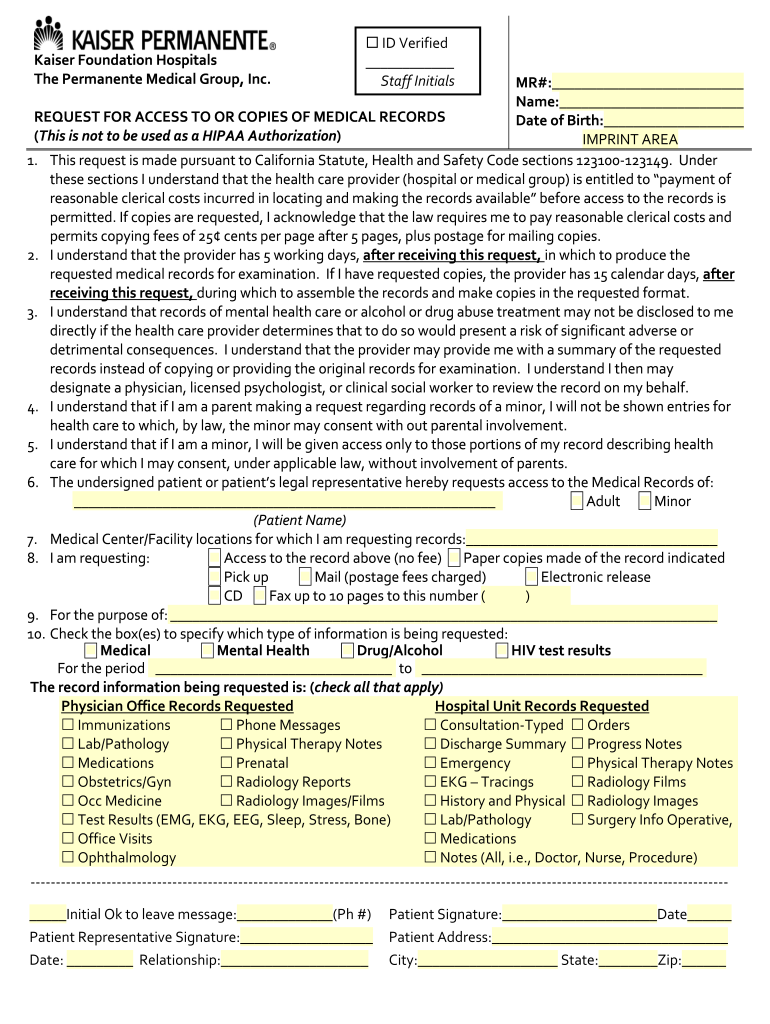
A request for medical records template hipaa structure should make the requested disclosure understandable without forcing the reader to interpret vague language. If the patient is requesting records for personal access, the form should state that directly. If the patient wants the provider to send information to a third party, identify the recipient and destination. If only selected records are wanted, describe those records and the applicable dates.
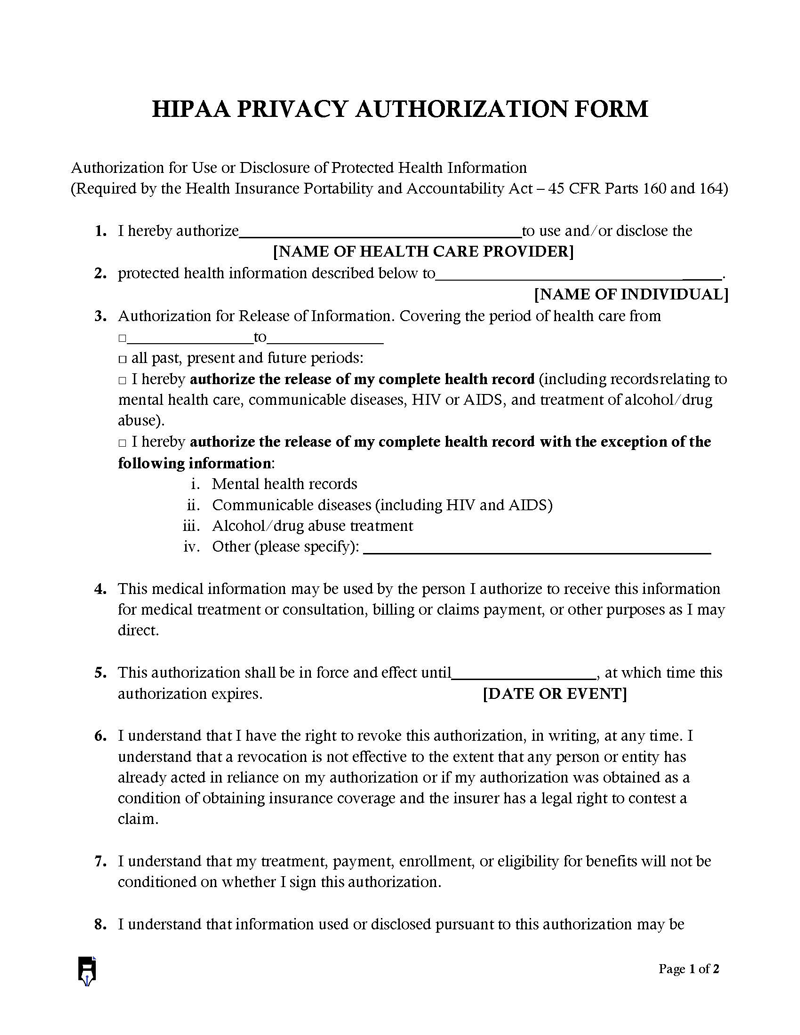
Authorization language should also be handled carefully. A useful authorization generally identifies the information to be disclosed, the person or entity authorized to disclose it, the person or entity receiving it, the purpose of the disclosure, and an expiration date or event. The patient or authorized representative should sign and date the document. HHS guidance also addresses written requests that direct a covered entity to send information to a designated third party.
A template should not be described as an official Hawaiʻi form unless the relevant organization actually issued it. Generic forms can help illustrate the structure of a request, but healthcare providers may have additional institutional requirements. For that reason, the most reliable workflow is to compare a prepared request against the current instructions of the specific Hawaiʻi provider before submitting it.

What information should be requested?
The answer depends on why the records are needed. For a new healthcare provider, useful material may include recent visit notes, diagnoses, medication information, allergies, laboratory results, imaging reports, and relevant diagnostic images. For an insurance matter, the requester may also need billing or claim-related documentation. For a legal matter, a broader record set may be necessary, depending on the issue being evaluated.
Do not automatically request every category simply because the form provides a checkbox. Overly broad requests can produce a large volume of material that is difficult to review and may include information that is not relevant to the stated purpose. On the other hand, a request that is too narrow can omit records that later prove important. The best scope is one that matches the actual objective of the request.
Sensitive information deserves special attention. Mental health information, substance-use treatment records, HIV-related information, psychotherapy notes, and other specially protected information can be subject to additional rules or restrictions. A generic authorization should not be treated as a guarantee that every category can be released under identical conditions. When such information matters, identify it carefully and follow the custodian’s specific instructions.
How to write the request step by step
Start with a direct statement identifying the patient and explaining the request. For example, the body can state that the patient is requesting copies of medical records maintained by the named facility for a specified period. The statement should make clear whether the records should be sent to the patient or to another designated recipient.
Next, list the records and dates. Avoid unnecessary legal language when plain language will do. A practical request might state that the patient wants “complete medical records for treatment between January 1, 2023 and December 31, 2025, including physician notes, laboratory results, imaging reports, and diagnostic images.” If only one encounter is needed, state the encounter date and the specific records.
Finish with delivery instructions, contact information, signature, and date. If someone is signing for the patient, identify the person’s relationship or representative authority as appropriate. Keep a copy of the submitted request and any confirmation received from the provider. If the provider asks for clarification, respond using the same identifying information so the records department can connect the follow-up with the original request.
Fees, timing, and delivery format
HHS explains that HIPAA generally permits reasonable, cost-based fees for copies in circumstances where fees are allowed, while state law can provide greater protections or lower limits. A patient should therefore avoid assuming that every medical-record request is either entirely costless or subject to an arbitrary copying charge. The applicable provider process and governing law should be checked before relying on a fee estimate.
HIPAA generally gives a covered entity up to 30 days to act on an individual’s access request, with a possible additional 30-day extension in certain circumstances. The provider must follow the applicable requirements for notifying the requester when an extension is used. This federal timeframe should not be confused with a provider’s shorter internal processing estimate, such as the timeframe published by Kaiser Permanente Hawaiʻi for certain detailed electronic requests.
When selecting a delivery format, the requester can state a preference for electronic records, paper copies, or another available format. HHS generally recognizes a right to receive information in the form and format requested when it is readily producible in that form and format. Diagnostic images can also fall within the access right, although large file sizes or technical considerations may affect the practical delivery method.
Common mistakes to avoid
The most common mistake is insufficient identification. A request with a partial name and no date of birth or other useful identifier can create unnecessary work for the records department. Another common problem is an unclear date range. “All recent records” is less useful than a specific period. If the patient does not know the exact date, an approximate range can still be better than leaving the period undefined.
A second mistake is confusing the provider that treated the patient with the provider that owns the requested record. A physician may have treated the patient at a hospital but maintained records separately from the hospital’s own chart. Likewise, a radiology practice may hold the original images while the hospital retains only the report. The requester should identify the likely custodian for each important category.
A third mistake is failing to distinguish access from disclosure. A patient requesting their own records is not necessarily completing the same transaction as a patient authorizing a lawyer or insurer to receive records. If the purpose is third-party disclosure, the authorization should identify the recipient and scope clearly. If the purpose is personal access, the request should say that directly.

Privacy and sensitive records
Medical records contain information that can affect healthcare, insurance, employment, legal matters, and personal privacy. A request should therefore contain only the information needed to identify the patient and process the request. Avoid including unnecessary clinical details in an unsecured email subject line or other exposed communication channel.
Special categories may require additional authorization or may be governed by separate federal or state confidentiality rules. The presence of a checkbox on a generic form does not establish that the record holder must release the information under every circumstance. If the request involves psychotherapy notes, substance-use treatment, HIV-related information, or other specially protected material, the requester should carefully follow the provider’s current instructions.
Once information has been properly released to an authorized recipient, the privacy protections governing the recipient may differ depending on the recipient and the circumstances. A good authorization therefore makes the recipient, purpose, scope, and duration understandable before the information leaves the original healthcare organization.
Practical Solution
The most practical way to use a hawaii medical records request template free or any other generic template is to treat it as a preparation checklist rather than automatically assuming that it is the official form of a Hawaiʻi provider. First identify the exact healthcare organization. Then locate its current medical-records or health-information instructions. Compare those instructions with the prepared request and transfer the necessary information into the provider’s current form if one is required.
Next, create a precise records scope. Write down the patient’s identifying information, treatment locations, physician names when known, date range, requested record categories, intended recipient, and preferred delivery method. If the request concerns a legal matter, insurance claim, disability determination, or transfer of care, state the purpose accurately. If sensitive information is relevant, identify it rather than assuming that a generic authorization automatically covers it.
Finally, submit the request through the provider’s specified channel and retain a copy of what was sent. Record the date of submission and any confirmation number or correspondence. If the provider requests clarification, respond promptly and preserve the updated communication. This simple tracking process is particularly useful when records are requested from multiple facilities or when several date ranges and record categories are involved.

For readers looking specifically for a hawaii medical records request template free pdf, the key issue is not merely finding a document with the right title. The document should match the actual purpose of the request and the current process of the organization holding the records. A generic PDF-style form can illustrate the necessary fields, but an official provider form may contain additional instructions or authorization language that should take precedence.
Likewise, a search for hawaii medical records request template free download may produce generic forms, third-party templates, and provider-specific documents. These should not be treated as interchangeable. A form issued by a Hawaiʻi hospital, a form used by a national healthcare organization, and a generic HIPAA authorization may look similar while serving different workflows. Always verify the source and current status of any document before relying on it for an actual records request.

A hawaii medical records request template hawaii should therefore be understood as a practical document structure rather than a single mandatory statewide form. The same principle applies to searches for a hawaii medical records request template oahu or a provider-specific version. The record holder, purpose of disclosure, patient status, requested information, and recipient can all affect the appropriate procedure.
When comparing a medical record request template hipaa with a provider’s current authorization, look for the core elements: patient identification, information to be disclosed or accessed, recipient information when applicable, purpose, dates or scope, expiration terms where required, and signature. A form that omits essential information may cause delays even when the request itself is legitimate.

It is also useful to distinguish a request for medical records template from a release authorization. A request can be written as a direct access request when a patient wants their own information. An authorization becomes especially important when the patient directs the provider to disclose information to another person or organization. The safest wording makes that purpose unmistakable.
Readers searching for hawaii pacific health medical records should also consider whether the needed information is already available through the organization’s patient-facing health-record services. A portal may provide commonly requested information, while a formal request may be appropriate when the patient needs a more detailed record set or needs information delivered to another recipient. The distinction can save time and help the requester choose the correct workflow.
For Kaiser patients, the phrase hawaii medical records request template kaiser points to a particularly important principle: provider-specific instructions matter. Kaiser Permanente Hawaiʻi publishes separate information for medical records, forms, health summaries, pharmacy records, and other certifications. A generic authorization can help explain the structure of a request, but the current Kaiser Hawaiʻi process should be checked before submission.
A well-prepared request also makes later review easier. If the patient receives a large record set, the original request provides a reference for what should have been included. This is valuable when checking whether laboratory results, imaging reports, operative notes, consultation records, billing documents, or other requested material is present.
In practical terms, the strongest template is one that is specific without being unnecessarily complicated. It tells the records department exactly who the patient is, what records are wanted, what period is covered, where the records should go, and who has authority to request or receive them. That combination of precision and simplicity is more useful than a generic form filled with unnecessary language.

Reference Examples
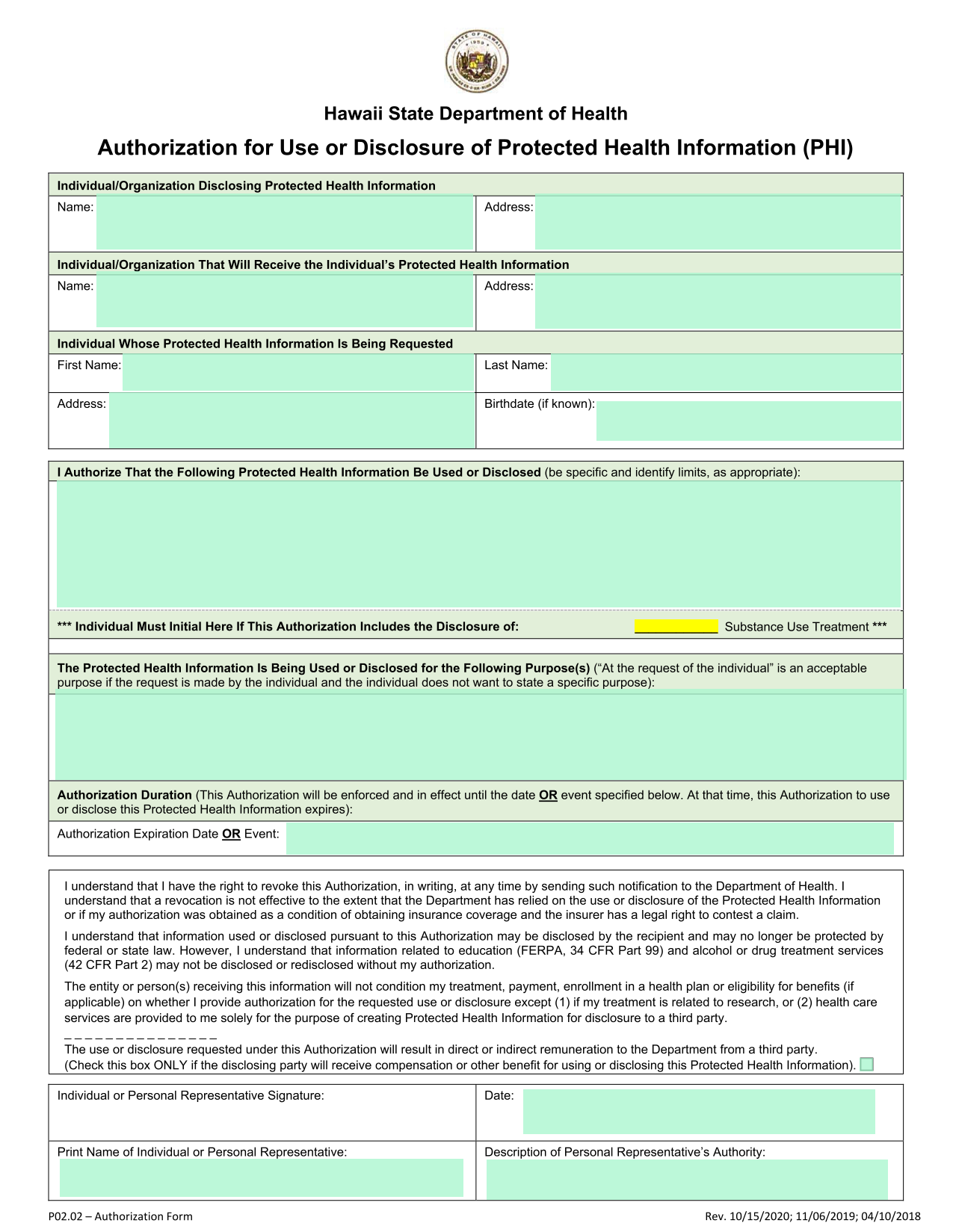
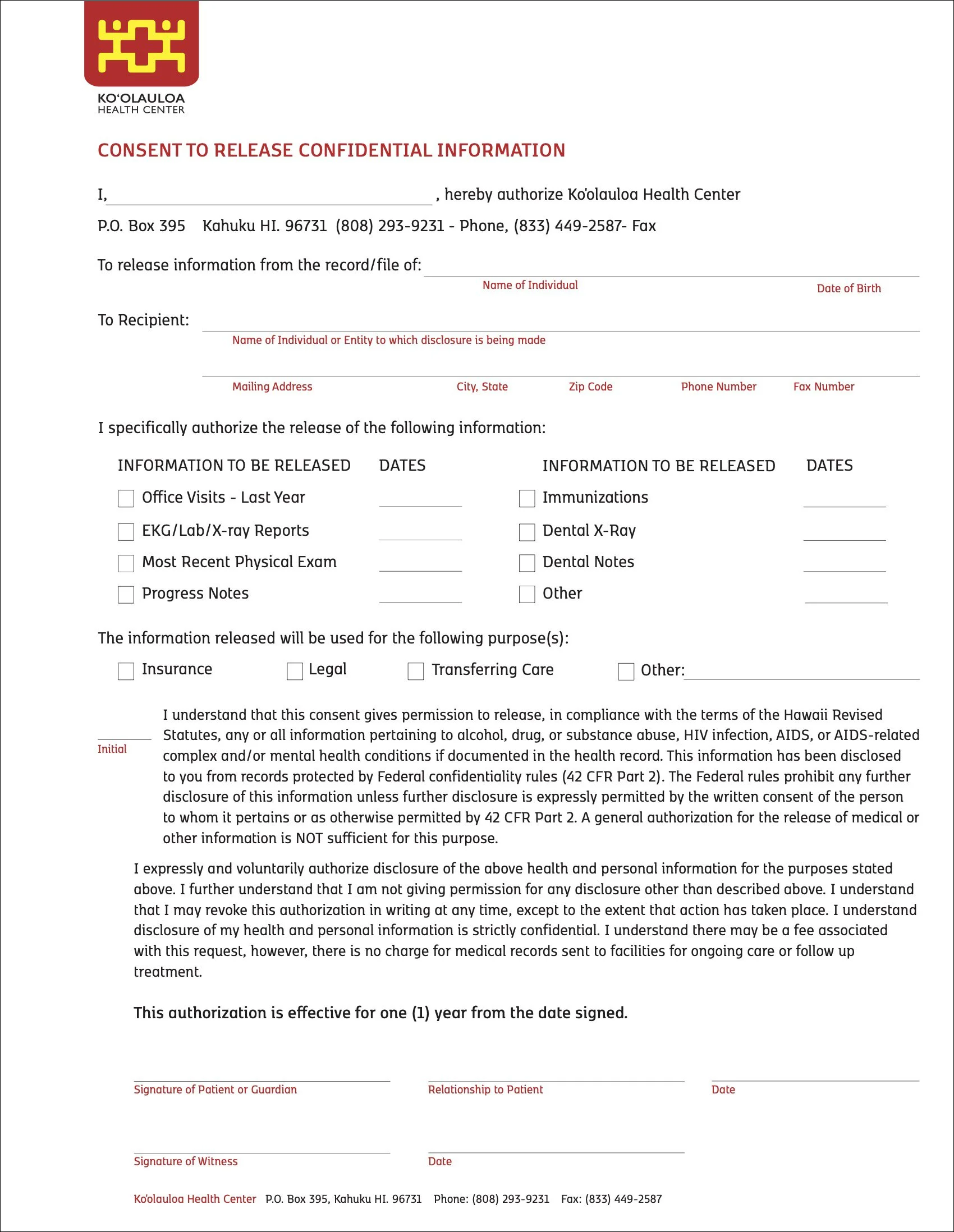
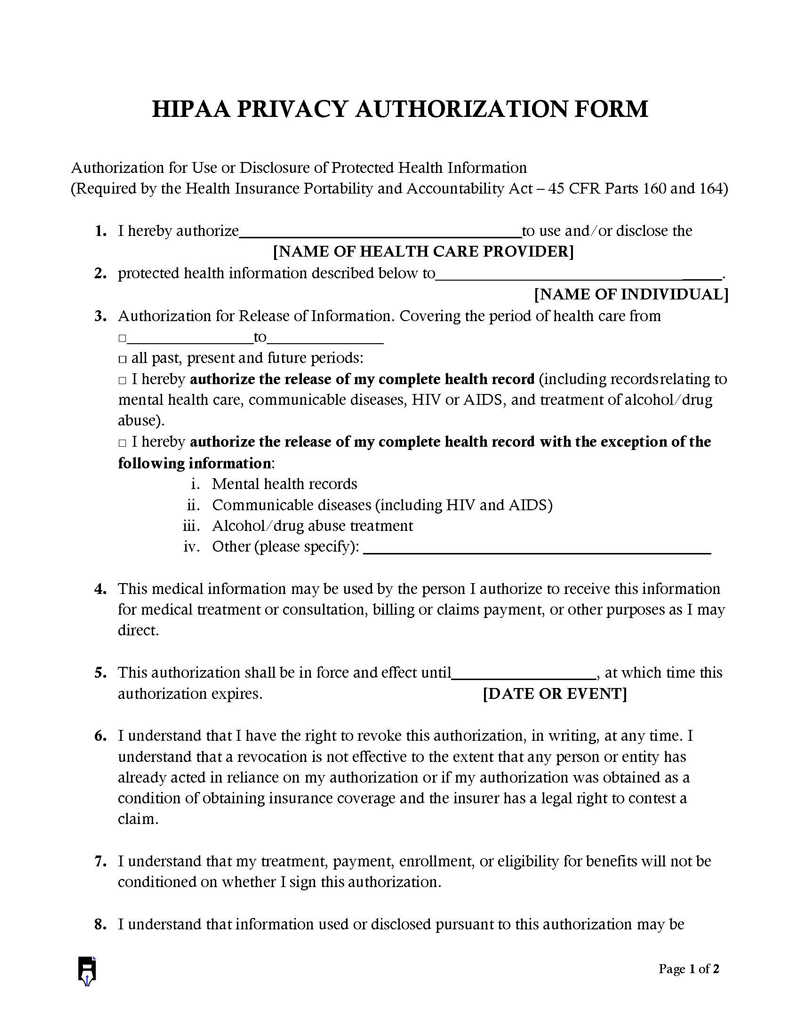
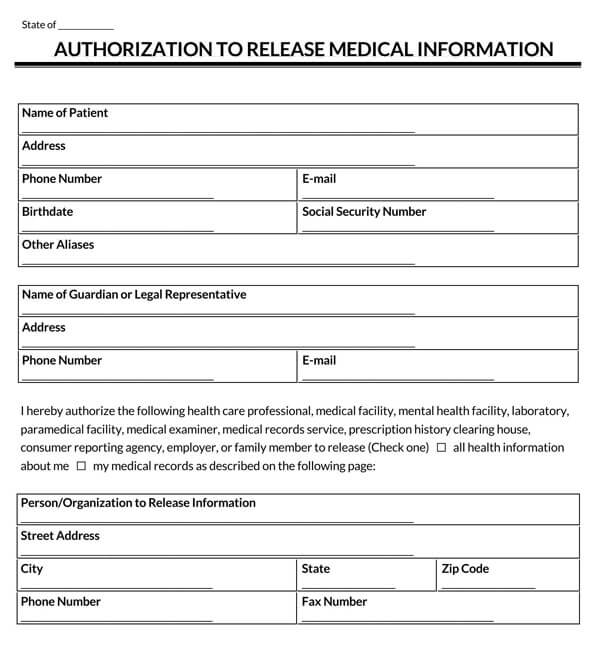
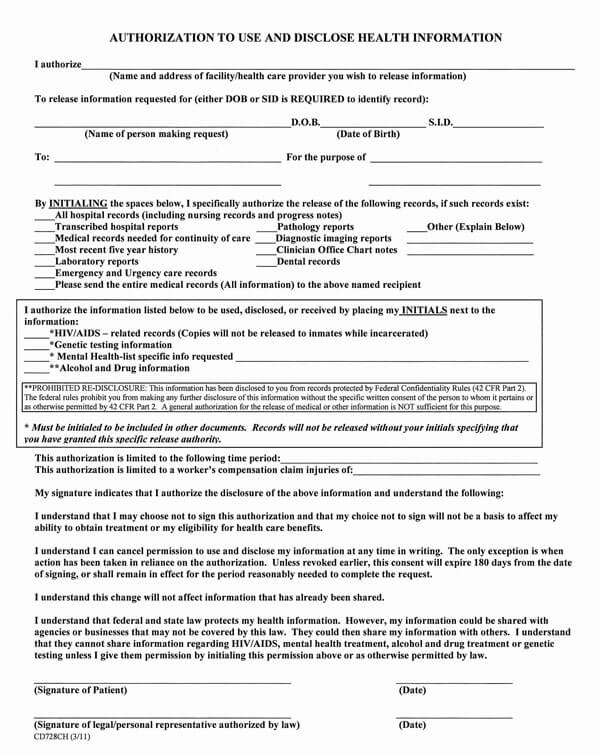
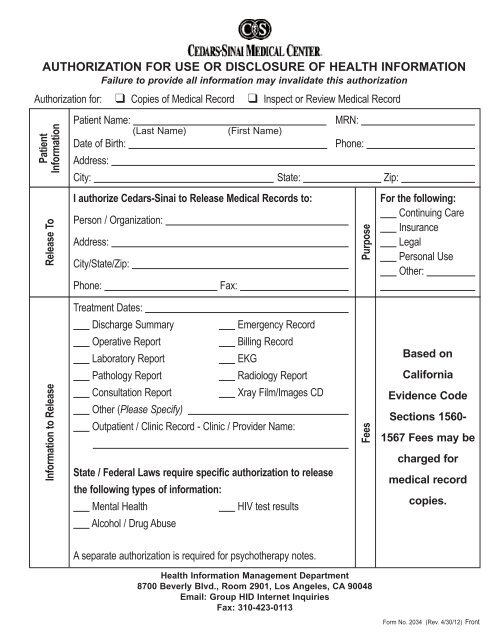
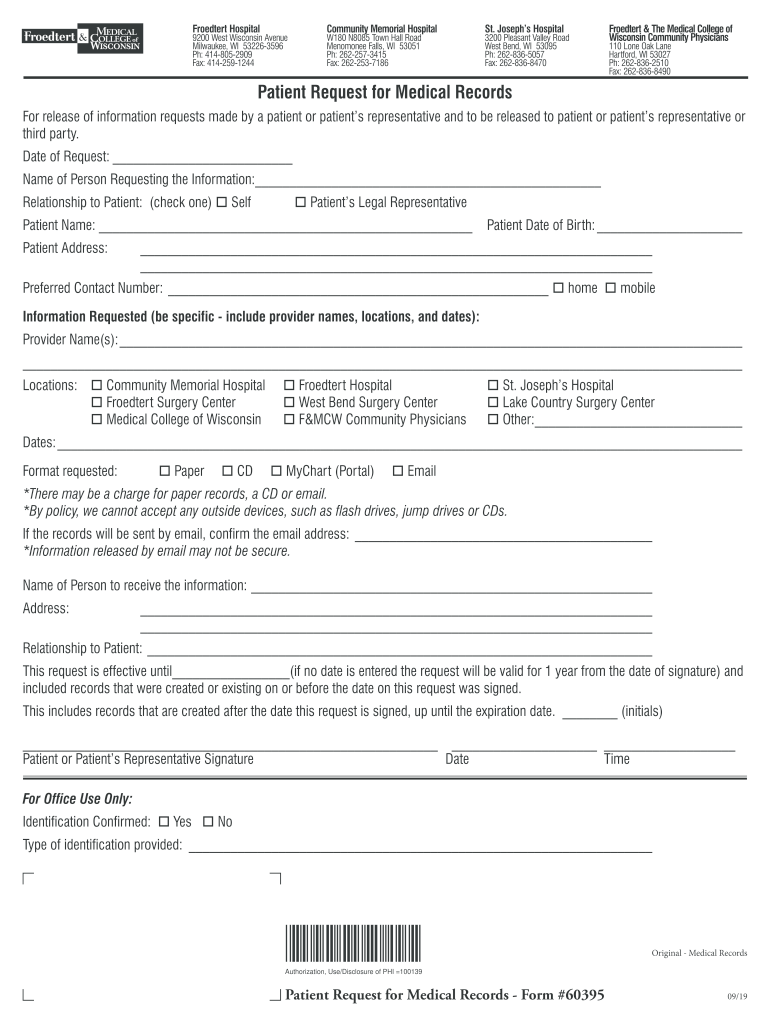
A hawaii medical records request Template is easiest to evaluate when readers can see how real authorization and access documents organize patient identifiers, record categories, dates, recipients, purposes, signatures, and privacy statements. The examples below come from different healthcare organizations and document sources, so they should be viewed as visual references rather than as interchangeable Hawaiʻi forms. In particular, a provider-specific document can contain requirements that differ from a generic authorization. The examples illustrate recurring design patterns that can help a requester understand what information a well-structured medical-record request commonly addresses.
These visual references also help distinguish a patient-access request from a release authorization. Some forms emphasize obtaining a copy of the patient’s own records, while others authorize disclosure to another person or organization. Looking at several layouts makes it easier to recognize where dates of service, recipient information, requested record categories, sensitive information, delivery preferences, expiration language, and signatures typically appear. For anyone preparing a Hawaiʻi request, the goal is not to reproduce another organization’s form, but to use the visual examples to check whether the planned request is clear, complete, and appropriately scoped.
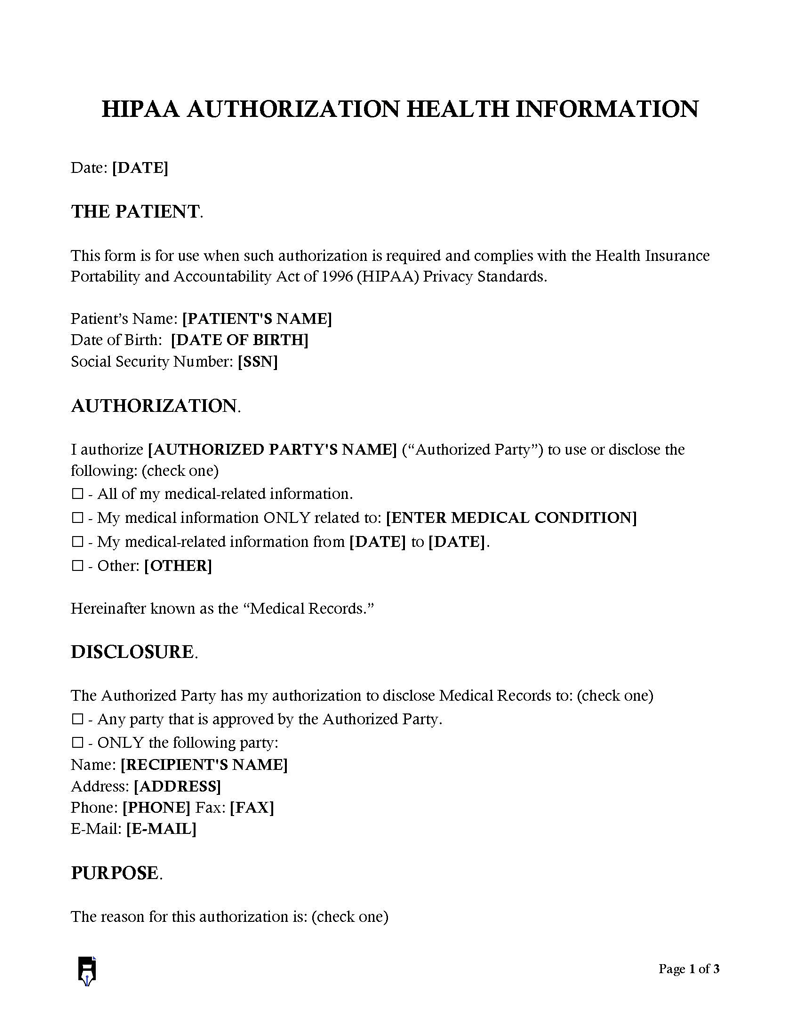
HIPAA Authorization Health Information
Source: DocTemplates
Authorization to Release Medical Information
Source: DocTemplates
Authorization to Use and Disclose Health Information
Source: DocTemplates
Authorization to Release Protected Health Information
Source: Mayo Clinic
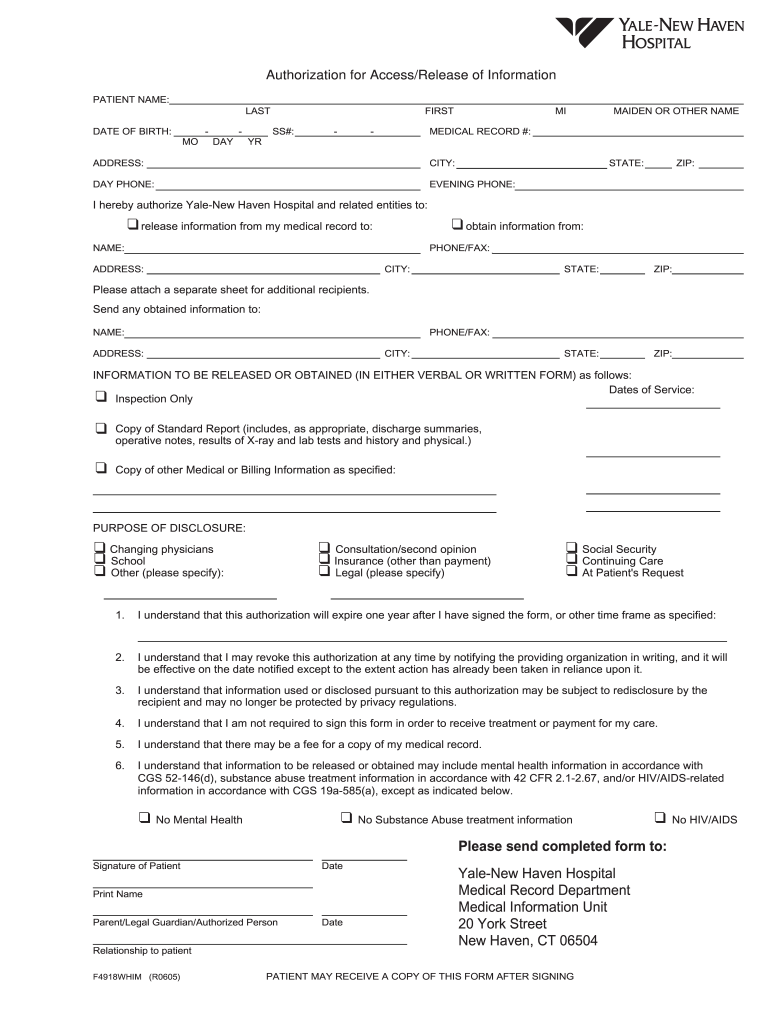
Authorization for Access/Release of Information
Source: Yale-New Haven Hospital
Request for Access to or Copies of Medical Records
Source: Kaiser Permanente
Authorization for Release of Protected Health Information
Source: Emory Johns Creek Hospital
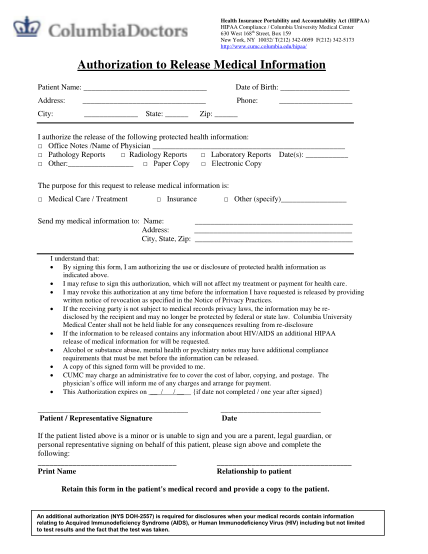
Authorization to Release Medical Information
Source: ColumbiaDoctors
Authorization for Use or Disclosure of Health Information
Source: Cedars-Sinai Medical Center
