Business development plays an important role in helping organizations find new opportunities, build valuable relationships, and achieve sustainable growth. Whether the position is called a business development representative, business development executive, business development manager, or director of business development, the core objective is usually connected to identifying opportunities and turning them into measurable business results.
Understanding business development roles and responsibilities is useful for employers creating job descriptions, managers building teams, and professionals preparing for a business development career. While responsibilities can vary by company and industry, most business development positions involve market research, lead generation, relationship management, strategic partnerships, sales collaboration, negotiation, and revenue growth.
A well-defined business development role also helps employees understand what is expected of them and gives organizations clearer ways to measure performance. The following guide explains the main responsibilities, required skills, qualifications, and success metrics associated with business development.
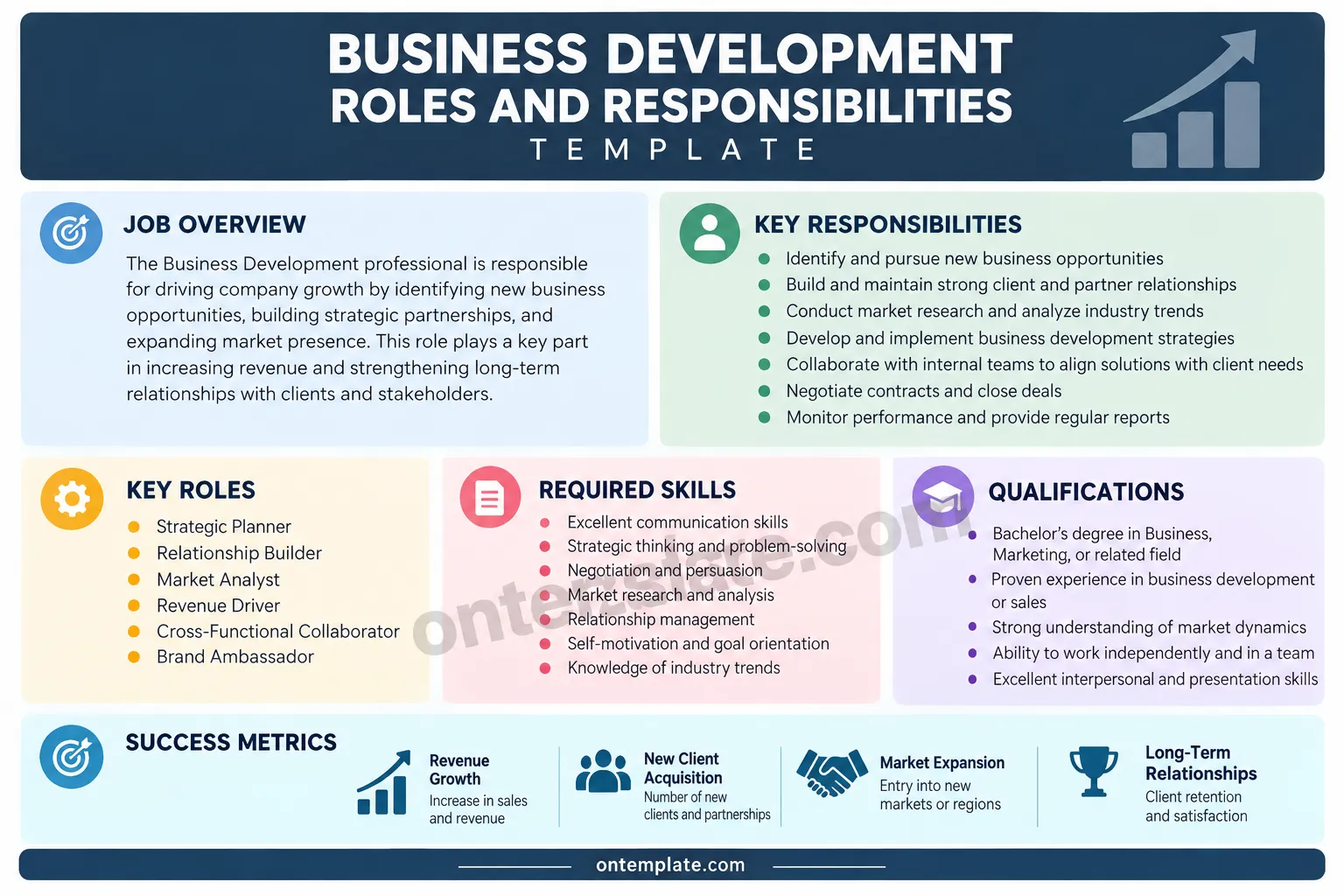
Image Title:
Alt Text:
Image Caption:
What Is Business Development?
Business development is the process of identifying and creating opportunities that can contribute to an organization’s long-term growth. These opportunities may include acquiring new customers, entering new markets, developing strategic partnerships, expanding existing accounts, or introducing new products and services to potential buyers.
Business development often overlaps with sales, marketing, account management, and strategy. However, business development generally has a broader focus than simply closing individual sales. Professionals in this field look for ways to create sustainable commercial relationships and open new sources of growth.
Business Development vs. Sales
Business development and sales are closely connected, but they are not always identical. Sales teams commonly focus on converting qualified prospects into customers and generating revenue from active opportunities. Business development may focus earlier in the process by finding prospects, developing partnerships, researching markets, and creating opportunities that sales teams can pursue.
In some organizations, one employee may perform both functions. In larger companies, business development and sales may operate as separate but closely coordinated teams.
Key Business Development Roles and Responsibilities
The specific duties depend on the organization’s size, industry, business model, and target market. Nevertheless, several responsibilities appear consistently across business development positions.
1. Identify New Business Opportunities
One of the primary responsibilities is finding potential opportunities for growth. A business development professional may research target companies, industries, geographic markets, customer segments, and emerging trends.
- Research potential customers and target accounts.
- Identify underserved market segments.
- Discover potential partnership opportunities.
- Monitor competitors and industry developments.
- Evaluate new markets and commercial opportunities.
- Build and maintain a pipeline of potential opportunities.
The objective is not simply to find as many leads as possible. Effective business development focuses on finding opportunities that fit the company’s products, services, capabilities, and strategic objectives.
2. Conduct Market Research
Business development professionals need a strong understanding of their market. Research helps them identify customer needs, competitive pressures, market gaps, and potential changes that could affect growth.
Typical research activities include analyzing industry reports, studying competitor offerings, speaking with prospects, reviewing customer feedback, and monitoring market trends. The information gathered can then be used to improve outreach strategies and business development plans.
3. Generate and Qualify Leads
Lead generation is another important part of business development. Professionals may use networking, referrals, events, digital outreach, partnerships, industry communities, and other channels to discover potential customers.
After identifying a lead, the professional must determine whether the opportunity is worth pursuing. Qualification may consider factors such as business needs, budget, decision-making authority, timing, strategic fit, and potential value.
4. Build Strong Business Relationships
Successful business development depends heavily on relationships. Professionals must establish trust with prospects, customers, partners, vendors, and other stakeholders.
- Communicate with prospects consistently.
- Understand customer objectives and challenges.
- Maintain relationships throughout long sales cycles.
- Follow up on meetings and opportunities.
- Develop relationships with strategic partners.
- Maintain accurate records of important interactions.
Relationship building is especially important when products or services have long decision cycles or involve multiple stakeholders.
5. Develop Business Development Strategies
Business development professionals may be responsible for creating strategies designed to reach specific growth objectives. A strategy could focus on entering a new market, increasing qualified leads, expanding partnerships, or developing a new customer segment.
A practical business development strategy typically defines the target audience, value proposition, channels, activities, resources, timelines, and performance indicators. The strategy should also be flexible enough to change when market conditions or customer needs change.
6. Collaborate With Sales and Marketing Teams
Business development rarely works in isolation. Close collaboration with sales and marketing teams can improve lead quality, messaging, customer targeting, and conversion opportunities.
Marketing may generate awareness and inbound leads, while business development identifies strategic opportunities and develops relationships. Sales can then take qualified opportunities through the purchasing process. In smaller organizations, the same person may handle several of these responsibilities.
7. Negotiate and Support Deal Closing
Depending on the organization, business development professionals may participate directly in negotiations. This can involve discussing pricing, contract terms, partnership structures, service requirements, or other commercial conditions.
Strong negotiation requires preparation, clear communication, an understanding of customer priorities, and the ability to create mutually beneficial agreements. The goal is to establish a sustainable relationship rather than simply achieve a short-term transaction.
8. Track Performance and Report Results
Business development activities should be connected to measurable outcomes. Professionals may use CRM systems, spreadsheets, dashboards, and other tools to track opportunities and evaluate performance.
Common metrics include the number of qualified leads, meetings generated, partnership opportunities, conversion rates, pipeline value, new customers, revenue contribution, and customer retention.
Essential Skills for Business Development Professionals
Business development requires a combination of interpersonal, analytical, strategic, and commercial skills. The exact requirements vary by position, but the following skills are commonly valuable.
- Communication: Clearly communicate ideas, value propositions, and business proposals.
- Negotiation: Reach practical agreements while protecting business interests.
- Relationship management: Build professional relationships with customers and partners.
- Strategic thinking: Connect individual opportunities with broader business objectives.
- Market research: Gather and interpret information about customers, competitors, and industries.
- Presentation: Present solutions and opportunities confidently to stakeholders.
- Problem-solving: Identify obstacles and develop practical solutions.
- Organization: Manage multiple prospects, follow-ups, meetings, and deadlines.
- CRM proficiency: Maintain accurate opportunity and relationship data.
- Goal orientation: Work consistently toward measurable business objectives.
Typical Qualifications for Business Development Roles
Requirements vary considerably depending on the employer. Some organizations prioritize formal education, while others place greater emphasis on commercial experience and demonstrated results.
Education
A bachelor’s degree in business, marketing, communications, economics, management, or a related field may be requested for many professional business development positions. However, relevant experience and industry knowledge can also be important considerations.
Professional Experience
Employers may look for experience in sales, account management, partnerships, consulting, marketing, customer success, or another commercially focused role. Experience working with a particular industry can also be valuable when specialized knowledge is required.
Industry Knowledge
A strong understanding of the company’s customers, products, competitors, and market can help business development professionals identify better opportunities. Industry knowledge also makes it easier to communicate credibly with potential customers and partners.
Business Development Success Metrics
Clear performance metrics help companies determine whether business development activities are producing meaningful results. Metrics should reflect the organization’s business model and sales cycle rather than relying on activity volume alone.
- New qualified leads: The number of relevant prospects entering the pipeline.
- Pipeline value: The potential commercial value of active opportunities.
- Conversion rate: The percentage of opportunities progressing to the desired next stage.
- New customer acquisition: The number of new customers generated.
- Revenue contribution: Revenue directly or indirectly associated with business development activities.
- Partnership growth: New strategic partnerships or business relationships established.
- Market expansion: Progress in entering new customer segments, territories, or industries.
- Customer retention: The ability to create relationships that continue over time.
How to Create an Effective Business Development Job Description
A strong job description should make the role easy to understand for both candidates and hiring managers. Instead of using broad statements such as “drive growth,” describe the specific activities and outcomes expected from the position.
Include Clear Responsibilities
List the core activities the employee will perform. For example, the description could mention prospect research, lead generation, partnership development, market analysis, client meetings, negotiations, and pipeline management.
Define Performance Expectations
Explain how success will be evaluated. Depending on the position, this could include qualified opportunities, revenue targets, new partnerships, market expansion, or relationship development.
Separate Required and Preferred Qualifications
Clearly distinguish essential requirements from desirable qualifications. This helps candidates understand whether they meet the fundamental expectations before applying.
Describe the Working Relationships
Explain who the business development professional works with. Common stakeholders include sales, marketing, product, operations, finance, customer success, executives, and external partners.
Practical Tips for Successful Business Development
Effective business development is not simply about contacting more prospects. Quality, relevance, consistency, and strategic alignment are equally important.
- Research before outreach: Understand the prospect’s business before starting a conversation.
- Focus on customer problems: Connect the company’s solution to a specific business need.
- Keep the pipeline organized: Use a CRM or structured tracking system for opportunities and follow-ups.
- Build relationships before transactions: Long-term trust can create opportunities beyond an immediate sale.
- Measure meaningful outcomes: Track progression and revenue-related results rather than activity alone.
- Work cross-functionally: Coordinate with sales, marketing, product, and leadership teams.
- Review the market regularly: Customer priorities and competitive conditions can change quickly.
Conclusion
Understanding business development roles and responsibilities provides a useful foundation for creating effective job descriptions, managing business development teams, and developing a career in the field. Although responsibilities differ between companies, the role commonly involves identifying opportunities, researching markets, generating and qualifying leads, developing relationships, creating strategic partnerships, supporting negotiations, and contributing to sustainable revenue growth.
The most effective business development professionals combine strong communication with strategic thinking, market knowledge, organization, and relationship-building skills. By defining responsibilities clearly and connecting them to measurable business outcomes, organizations can create business development roles that are easier to manage and more closely aligned with their growth objectives.
For employers and professionals creating a role profile, a structured template can make it easier to organize responsibilities, qualifications, skills, and success metrics in one clear format.
