A well-designed medical student case Template gives students a repeatable way to organize clinical information without losing the reasoning behind the case. The most useful format is not simply a blank page with headings. It should guide the writer from the presenting complaint and relevant history through examination, investigations, differential diagnosis, management, follow-up, and reflection. A good structure also makes it easier for a supervisor or examiner to see what information was selected, why it matters, and how the clinical story develops.
For students, the central challenge is usually deciding what belongs in the case and what should be left out. A case presentation can contain a large amount of information, but a strong presentation emphasizes clinically relevant facts rather than reproducing an entire patient record. The structure should help the student distinguish between background information, positive findings, important negatives, diagnostic evidence, clinical reasoning, treatment decisions, and outcomes.
Case reports have a somewhat different purpose from classroom or bedside presentations. The CARE framework for case reports organizes reporting around patient information, clinical findings, a timeline, diagnostic assessment, therapeutic intervention, follow-up and outcomes, discussion, patient perspective, and informed consent. That framework is useful for students because it demonstrates how a clinical story can be made transparent and logically traceable.

What a medical student case template should accomplish
The primary function of a case template is organization. Before writing, a student should be able to identify the patient’s presenting problem, the information needed to characterize it, the findings that change the differential diagnosis, and the investigations that answer specific clinical questions. A template creates a consistent order so that important information is less likely to be buried in a long narrative.
A useful template also supports clinical reasoning. Listing a diagnosis without explaining how the evidence supports it turns a case presentation into a collection of facts. Instead, the student should connect findings to hypotheses. For example, a symptom can be followed by relevant associated features, examination findings, laboratory results, imaging, and the reasoning that makes one diagnosis more likely than another. This approach mirrors the way medical students are expected to synthesize information rather than simply recall it.
The best structure is flexible enough to work across specialties. A medicine case may emphasize history, examination, laboratory data, and differential diagnosis, while a surgical case may require greater attention to imaging, operative findings, procedure details, and postoperative progress. Pediatrics, psychiatry, obstetrics, neurology, and emergency medicine may each have additional specialty-specific considerations. The core framework should therefore provide stable headings while allowing the student to expand sections that are clinically important.

Core sections to include
Patient identification and presenting problem
Begin with only the patient information that is necessary for the educational purpose of the case. Depending on the assignment, this may include age range, sex or gender where clinically relevant, occupation, relevant background, and the setting in which the patient presented. Real patient identifiers should not be placed into student documents unnecessarily. If the case is being prepared for publication or wider circulation, patient information must be appropriately de-identified.
The presenting complaint should be stated clearly and concisely. A useful case presentation does not make the audience search through several paragraphs to discover why the patient sought care. The chief complaint can be followed by a concise description of the immediate clinical context, including duration, severity, important associated symptoms, and circumstances surrounding presentation.
For educational cases, it is helpful to distinguish the chief complaint from the history of present illness. The first identifies the reason for presentation, while the second reconstructs the evolution of the problem. A template should make that distinction visible so students do not mix the patient’s original complaint with later findings discovered during evaluation.

History of present illness
The history of present illness should usually follow a logical sequence rather than a random list of symptoms. Depending on the complaint, students may describe onset, progression, location, quality, severity, timing, provoking or relieving factors, associated symptoms, previous episodes, and relevant exposures. The exact framework should be adapted to the complaint rather than applied mechanically to every patient.
Relevant medical, surgical, medication, allergy, family, and social history should be included when it changes interpretation of the current problem. The word relevant matters. A template should not encourage students to copy every historical detail into every case. A medication matters when it affects symptoms, risk, diagnosis, treatment, or prognosis. A family history matters when it changes clinical suspicion. A social history matters when it contributes to risk, exposure, adherence, or management.
Important negative findings can be just as valuable as positive findings. If a diagnosis depends partly on the absence of a particular symptom, documenting that absence can demonstrate reasoning. The same principle applies to examination and investigation results. Students should learn to record negatives selectively, especially when they narrow a differential diagnosis or rule out an important complication.

Physical examination and clinical findings
A case template should separate general observations from focused examination findings. Vital signs, general appearance, and clinically significant abnormalities establish the initial picture. The focused examination should then concentrate on systems relevant to the presenting complaint. This prevents the case from becoming a transcription of every examination maneuver performed.
Students should record findings in language that another clinician can understand. Instead of writing vague phrases such as “chest normal,” specify the relevant examination components and important findings. When an abnormality is present, describe its characteristics rather than simply naming it. This helps the audience understand why the finding matters diagnostically.
The examination section can also identify findings that influenced the next step. For example, an abnormal neurological finding may justify neuroimaging or specialist assessment, while a particular abdominal examination pattern may change the differential diagnosis. The template should therefore encourage students to think of examination as evidence rather than as a checklist completed independently of clinical reasoning.

Investigations and diagnostic reasoning
Investigations should be presented according to their clinical purpose. A strong case does not simply list laboratory values, imaging studies, or pathology results. It explains what question each investigation was intended to answer and highlights the findings that affected the diagnostic process. Normal results can be important when they reduce the probability of a competing diagnosis or establish a baseline.
When laboratory data are extensive, select the results that are relevant to the case. If a trend is clinically important, show the trend rather than presenting dozens of isolated values. A timeline or visual summary can make changes easier to interpret. For imaging, the student should identify the clinically meaningful finding and explain how it relates to the differential diagnosis rather than merely naming the imaging modality.
Differential diagnosis is one of the most educational parts of a case presentation. A template can provide a structured space for the leading diagnosis, important alternatives, supporting evidence, opposing evidence, and the investigation or observation that would help distinguish between them. This makes the reasoning visible and helps supervisors assess whether the student’s conclusion is supported by the available evidence.

A practical differential diagnosis section should not become an exhaustive list of every theoretically possible condition. The student should prioritize diagnoses according to clinical probability, severity, urgency, and relevance to the available findings. If a less likely diagnosis is included because it would be dangerous to miss, that reason can be stated explicitly.

Building a clear case timeline
A timeline is particularly useful when a case involves several visits, multiple investigations, changing symptoms, or treatment adjustments. CARE specifically recommends organizing important events chronologically because a timeline allows readers to see how the case unfolded rather than forcing them to reconstruct the sequence from prose.
A student timeline can begin with the first relevant symptom and continue through presentation, examination, investigation, diagnosis, treatment, response, and follow-up. Exact dates should only be included when appropriate and safe. For educational examples, relative labels such as “day 1,” “week 2,” or “follow-up visit” can make the chronology clear without exposing unnecessary identifying information.
The timeline should emphasize turning points. A test that changed the working diagnosis, an intervention that altered the clinical course, a new complication, or an important follow-up result deserves greater visual prominence than routine events. This makes the timeline useful for both case discussion and later revision.

Management, intervention, and follow-up
The management section should explain what was done and why. Depending on the case, this may include medication, procedure, surgery, supportive care, preventive measures, monitoring, referral, or lifestyle-related management. Students should distinguish between the intervention itself and the reasoning behind choosing it.
When medication is relevant, the educational case can record the drug, route, dose, frequency, duration, and reason for use when these details are appropriate to the assignment. For procedures, describe the intervention at the level required by the learning objective. Avoid inventing details that are not available in the source case, and avoid presenting a hypothetical treatment plan as though it were the actual management received by a patient.
Follow-up should answer a simple question: what happened after the intervention? Describe meaningful changes in symptoms, examination findings, investigations, treatment, adherence, complications, and outcomes. A good case template makes room for both improvement and lack of improvement because either can provide educational value.

Choosing between common document formats
Students often search for a medical student case template free because they need a practical starting point rather than a complicated publishing format. The important question is not whether a template has a particular price or label, but whether its structure supports the assignment. A simple document containing patient information, history, examination, investigations, assessment, plan, and reflection may be more useful for a bedside exercise than a journal-style manuscript.
A medical student case template pdf can be convenient when a course expects a printable worksheet or a fixed visual layout. A PDF-style format is particularly useful for handwritten preparation, clinical skills exercises, or structured review. However, students should check whether their institution expects a particular format before treating any generic template as an official requirement.
For collaborative coursework, a medical student case template google docs can be useful because students can revise sections, leave comments, and maintain a shared working draft. The underlying organization should remain the same: clear patient context, relevant history, findings, diagnostic reasoning, management, and learning points. The software or document format is secondary to the quality of the clinical structure.

A medical student case template word is another practical option when the assignment requires a conventional editable document. Word-style documents are well suited to longer narrative cases, reflective assignments, and case reports where headings and paragraphs matter more than slide design. The student can also use a consistent heading hierarchy to make the final document easier to review.
Students sometimes search for a medical student case template free download when they want an editable starting point. Before using any externally sourced file, inspect the headings carefully and remove fields that are unnecessary for the assignment. More importantly, never assume that an online template represents an official school, hospital, or journal requirement unless that requirement has been verified.

A medical student case template for students should therefore be judged by usability. It should help a learner move from raw clinical information to a concise problem representation and prioritized assessment. A template that contains too many decorative fields can actually make case preparation harder by encouraging students to fill boxes rather than analyze evidence.
Case study versus case report
The terms case study, case presentation, and case report are related but should not be treated as identical. A case presentation is commonly designed for an audience such as a supervisor, clinical team, or classroom. Its purpose is often to communicate the patient’s current situation and demonstrate clinical reasoning. A case report is a formal written account intended to communicate a noteworthy clinical observation and may be prepared for scholarly publication.
A medical case study template may therefore be broader than a publication-oriented case report format. An academic assignment might ask the student to analyze the clinical problem, explain the evidence, discuss alternatives, and identify learning points. A publication-style report may require more formal patient information, a chronology of care, discussion of relevant literature, patient perspective, and informed consent.
The CARE guidelines provide a useful reference point for formal case reporting. Their checklist includes title, keywords, abstract, introduction, patient information, clinical findings, timeline, diagnostic assessment, therapeutic intervention, follow-up and outcomes, discussion, patient perspective, and informed consent. The framework is intended to improve completeness and transparency, but a classroom assignment may reasonably combine or simplify some of these sections.

Using examples without copying them
A medical student case report example can help a learner understand how much detail is appropriate and how clinical reasoning is expressed in narrative form. Examples are most useful when students analyze their structure rather than copy wording. Look at how the author introduces the patient, selects findings, presents investigations, explains diagnostic uncertainty, describes intervention, and identifies the main lesson.
Students should also pay attention to what examples leave out. Strong case reports do not necessarily contain every piece of information collected during patient care. They select details that support the purpose of the report. The CARE guidance similarly emphasizes a focused case narrative and encourages authors to identify what the case adds, organize what happened chronologically, and explain why conclusions were reached.
Community discussions can also reveal practical student concerns. Someone searching for a medical student case template reddit may encounter suggestions about presentation order, note organization, or school-specific expectations. Such discussions can be useful for discovering common workflow problems, but they should not replace course instructions, supervisor guidance, institutional policies, or authoritative reporting standards.

Presentation slides for oral case discussion
A medical case study powerpoint template can be helpful when the assignment requires an oral presentation. Slides should not reproduce the entire written case. Instead, each slide should answer one question: Who is the patient? What brought them to care? What findings matter? What are the leading diagnostic possibilities? What investigations changed the assessment? What treatment was provided? What happened afterward?
A medical case study presentation template should use visual hierarchy to distinguish facts, interpretation, and conclusions. Short phrases, selected laboratory values, focused images, timelines, and simple diagrams are often more effective than dense paragraphs. If a slide contains a large amount of text, the presenter may end up reading instead of explaining the case.
The presentation should also maintain confidentiality. Patient names, record numbers, exact addresses, unnecessary dates, and identifiable photographs should not appear in educational material unless there is an appropriate reason and authorization. De-identification is an explicit consideration in formal case reporting, and informed consent may be required before a case is submitted for publication. :contentReference[oaicite:4]{index=4}

Case study format for medical students
A useful case study format for medical students can be organized into nine practical blocks: patient context, presenting complaint, history, examination, investigations, assessment and differential diagnosis, management, outcome, and learning reflection. This format is compact enough for routine academic work while still encouraging the student to explain the reasoning behind the case.
The patient context should establish the clinical setting. The history should tell the story. Examination and investigations should provide evidence. Assessment should synthesize that evidence. Management should show the clinical response. Outcome should close the episode of care, while reflection should identify what the student learned or what uncertainty remains.
When the case is intended for publication, the structure can be expanded using the CARE framework. When the case is intended for an oral presentation, the same information can be condensed into a slide sequence. This makes the underlying template reusable across different assignments without forcing every case into one rigid format.

Common mistakes to avoid
One common mistake is excessive detail without prioritization. A long history is not automatically a better history. Students should ask whether each fact changes the interpretation of the case, supports or weakens a diagnosis, affects management, or contributes to the learning objective. If it does none of these things, it may not belong in the final presentation.
Another mistake is confusing a diagnosis with an explanation. Writing “pneumonia” or “migraine” does not demonstrate how the conclusion was reached. The case should show the relevant evidence and explain how competing diagnoses were considered. This is particularly important in assessed presentations because clinical reasoning is often one of the main learning objectives.
A third mistake is presenting invented information as though it came from the patient. If an assignment asks students to construct a hypothetical case, label it clearly as hypothetical. If the case is based on a real patient, use only information that is actually available and appropriately de-identified. Do not fill missing laboratory values, treatment details, dates, or outcomes with plausible guesses.

Practical Solution
Start by creating a one-page working outline before writing the final case. Put the presenting complaint at the top, then record only the history that affects the problem. Under that, add the most important examination findings and investigations. Next, write a one- or two-sentence problem representation that summarizes the patient, the major clinical features, and the central diagnostic question. This prevents the final document from becoming a chronological transcript of everything that happened.
Next, build the differential diagnosis before writing the final assessment. For each leading possibility, identify evidence that supports it and evidence that argues against it. Then identify which investigation, examination finding, or clinical event changed the ranking. This creates a visible reasoning chain. After that, document the management and follow-up in chronological order, including meaningful changes and the reasons for those changes. If the case is being prepared as a formal report, compare the structure against the CARE checklist before submission.
Finally, adapt the same core material to the required output. For a written assignment, use clear headings and concise paragraphs. For a bedside presentation, compress the case into a short problem representation followed by prioritized findings and assessment. For slides, turn the chronology, diagnostic reasoning, and outcome into visual elements rather than paragraphs. For a publication-oriented case report, add the formal components required by the target journal and confirm de-identification and consent requirements. The template should serve the clinical story, not dictate it.

A useful quality check is to ask whether another student could understand the case without asking where the conclusion came from. If the answer is no, strengthen the connection between evidence and interpretation. Ask whether the most important diagnostic uncertainty is visible, whether the timeline is understandable, and whether the outcome is stated clearly. These checks often improve a case more than adding additional paragraphs.
The final review should also remove unnecessary patient identifiers, unexplained abbreviations, unsupported claims, and duplicated information. Verify that laboratory units and clinical terminology are accurate, that numerical values have not been altered during transcription, and that every statement presented as a patient fact is actually supported by the source case. A careful final review protects both educational quality and patient confidentiality.

How to make the template easier to study from
A case template can become a revision tool when it captures the reasoning behind the case rather than merely documenting it. After completing a case, students can highlight the findings that changed the differential diagnosis, identify the most informative investigation, and write one sentence explaining the key clinical lesson. Over time, this produces a collection of structured cases that can be reviewed before examinations or clinical assessments.
Another useful technique is to keep the original case information separate from the student’s interpretation. For example, “temperature 38.4°C” is an observed result, while “supports an infectious process” is interpretation. Keeping these levels distinct makes it easier to revisit reasoning later if new evidence becomes available or if a supervisor challenges the initial conclusion.
The same distinction is valuable during oral presentation. A student can first state the important facts, then provide the synthesis: “Given these findings, my leading diagnosis is X because…” This simple separation makes the presentation clearer and gives the listener an opportunity to understand the evidence before hearing the student’s conclusion.

When a template should be customized
No generic structure should override an assignment brief or clinical supervisor’s instructions. If a course specifies particular headings, use those headings. If a journal requires a specific reporting structure, follow the journal’s current author instructions. CARE is a broadly useful reporting framework, but it is not a substitute for the requirements of a particular publication venue.
Customization is also appropriate when the clinical problem demands it. A neurological case may require detailed neurological examination and localization. A surgical case may require operative findings. A psychiatric case may need a carefully structured mental status examination and risk assessment. An obstetric case may need pregnancy-specific chronology and relevant maternal and fetal findings. The template should provide a framework while allowing clinically meaningful detail.
The most effective customization is selective. Add fields when they answer a real clinical or educational need, and remove fields that encourage irrelevant information. This keeps the template compact and reduces the temptation to fill every blank simply because it exists.

Final checklist before submitting a case
- Confirm that the presenting complaint and clinical context are immediately clear.
- Check that the history contains relevant information rather than an unfiltered record.
- Make sure important examination findings are described precisely.
- Identify the investigations that materially affected the assessment.
- Explain the leading diagnosis and the most important alternatives.
- Present the timeline in a logical sequence when multiple events are involved.
- Describe management and explain significant changes in treatment.
- State the outcome and meaningful follow-up findings.
- Separate observed patient facts from interpretation or hypothetical examples.
- Remove unnecessary identifying information from educational materials.
- Check spelling, units, abbreviations, dates, and clinical terminology.
- For formal case reports, review the relevant CARE items and the target journal’s requirements.

A strong case template ultimately does three jobs at once: it organizes information, makes clinical reasoning visible, and creates a consistent record of what the student learned. Whether the final format is a document, a printable worksheet, shared coursework, or presentation slides, the underlying principles remain the same. Start with the patient’s problem, select relevant evidence, explain the reasoning, describe what happened, and identify the learning value.
For students who want a reliable starting point, the most useful approach is to build one master structure and adapt it for different assignments rather than searching for a completely different format every time. The resulting template can remain simple while still reflecting the major elements expected in clinical case presentation and formal case reporting.

Reference Examples
The following visual references illustrate different ways a medical student case Template can organize clinical information. Some emphasize the formal structure of a case report, while others show patient history, clinical findings, diagnostic workup, treatment planning, timelines, outcomes, or presentation flow. They are useful for comparing layouts and recognizing which visual elements make a case easier to follow. The most valuable feature across these examples is not the color scheme or decorative design but the underlying hierarchy: patient context first, clinical evidence next, interpretation after that, and outcome or learning points at the end.
These references can also help students distinguish between a written case report and an oral case presentation. A report may require more narrative detail, while slides benefit from concise statements, timelines, diagrams, and carefully selected data. When adapting any visual structure, students should preserve confidentiality, verify the requirements of their course or publication venue, and treat external examples as design references rather than institutional instructions. The goal is to create a clear, clinically coherent representation of the case rather than reproduce another author’s wording or layout.
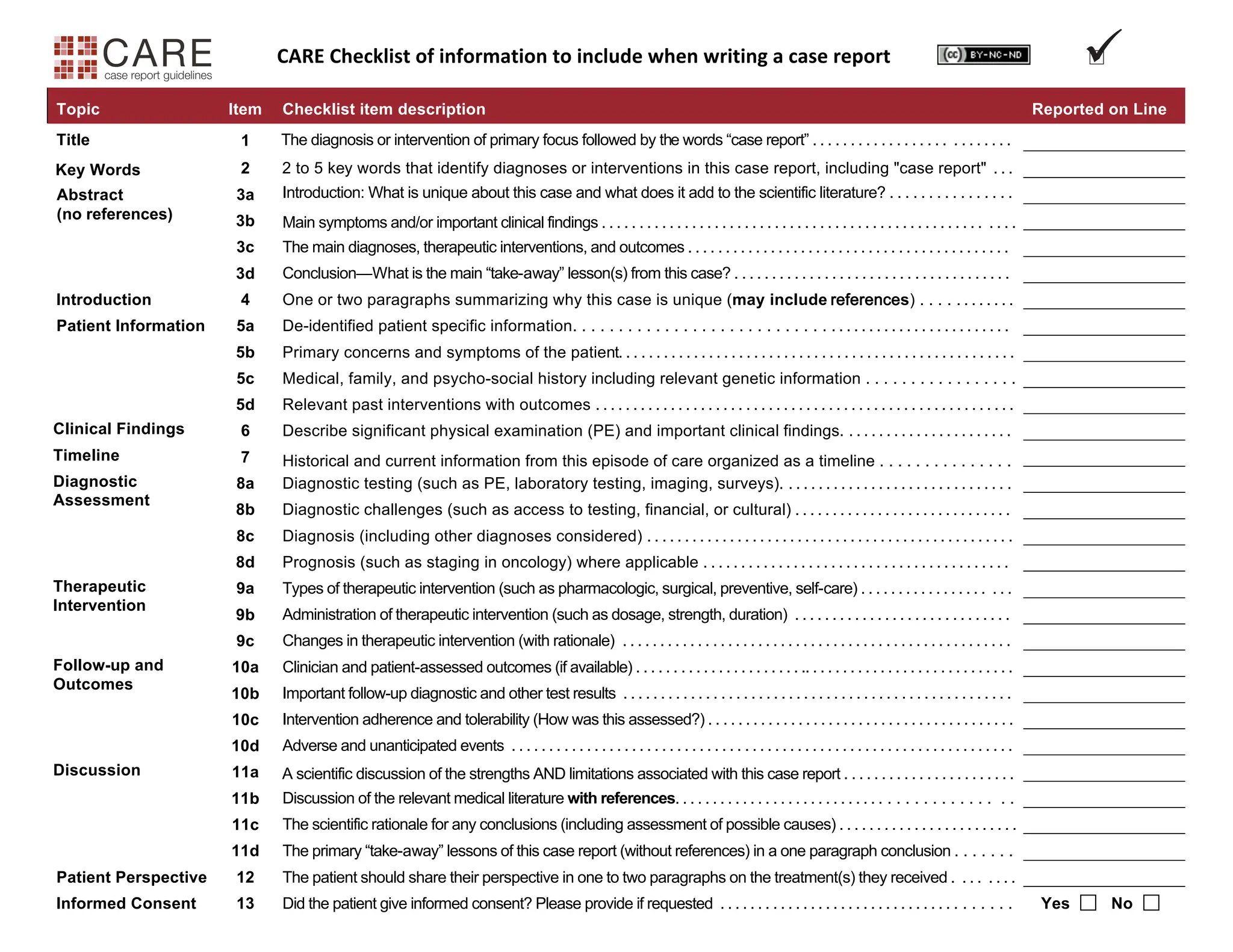
CARE Checklist of information to include when writing a case report
Source: CARE Case Report Guidelines
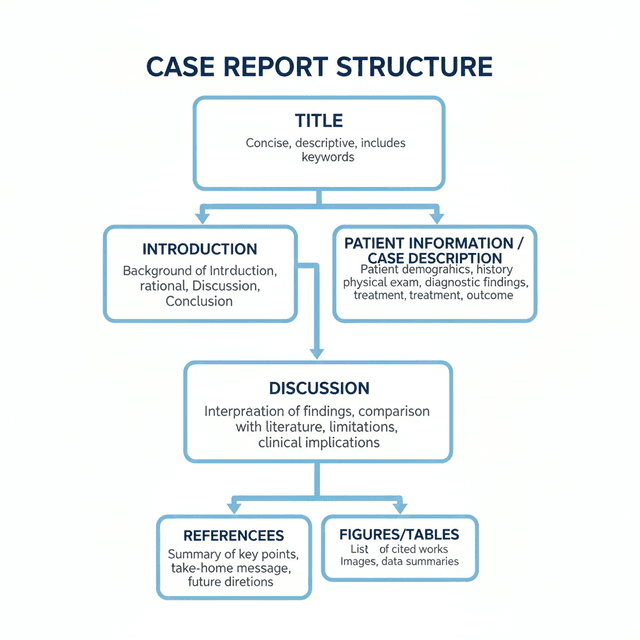
Case Report Structure
Source: Alpha Publication

How to Write a Case Report Using the CARE Guidelines
Source: Asad Naveed
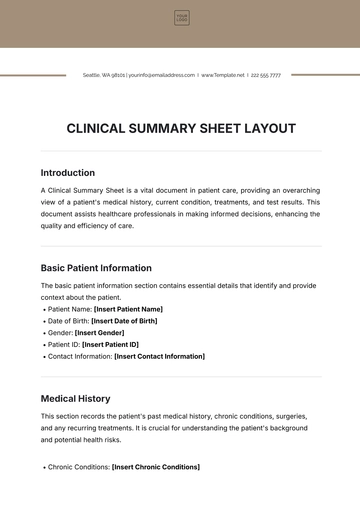
Clinical Summary Sheet Layout
Source: Template.net

Creating a Professional Case Study Presentation
Source: Visme

Clinical Case Medical Presentation Template
Source: PoweredTemplate

Medical Case Study Presentation Template
Source: Visme
How to Structure a Clinical Case Report
Source: Springer Nature Research Communities
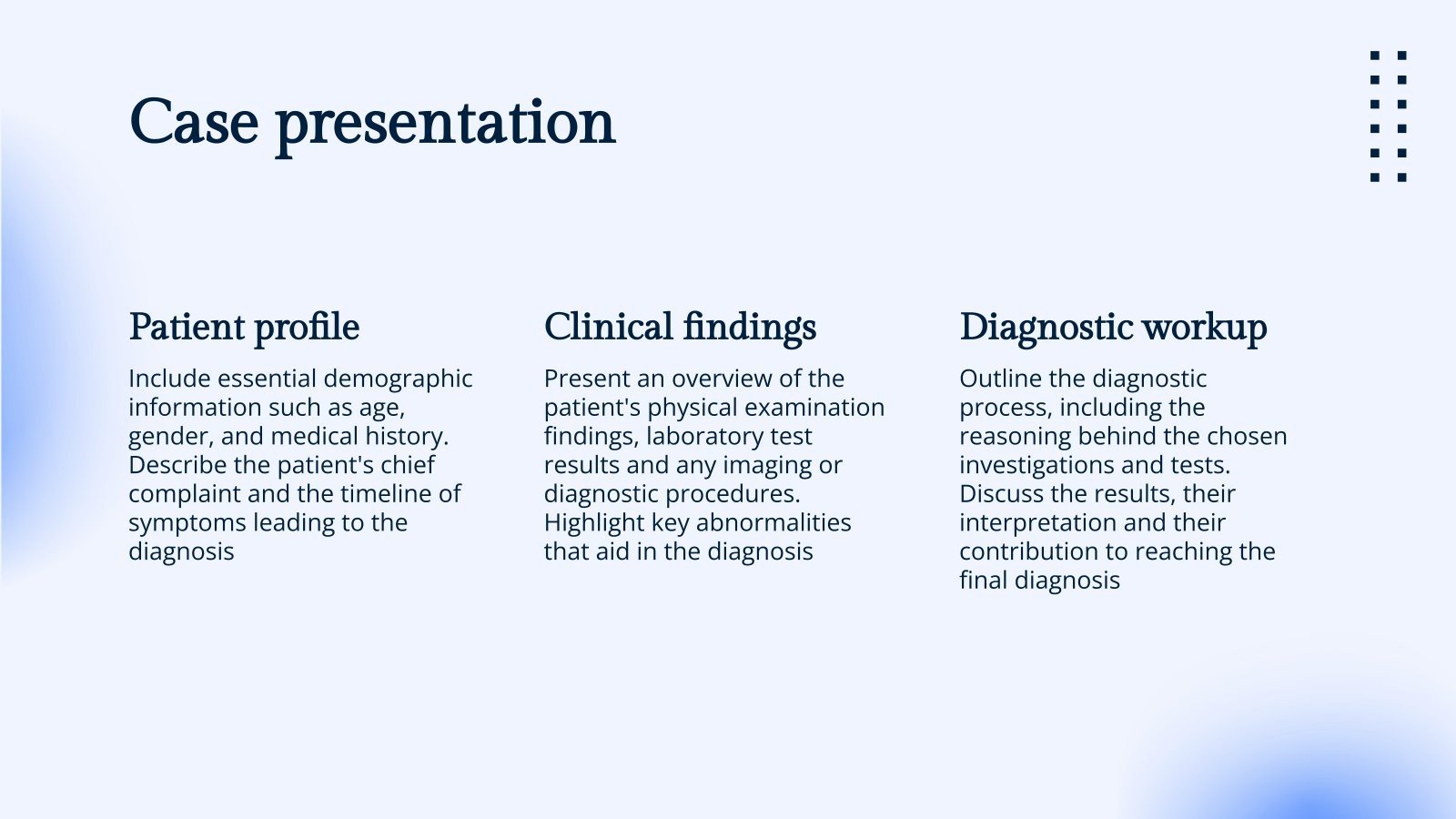
Case Presentation: Patient Profile, Clinical Findings, and Diagnostic Workup
Source: Slidesgo

Helse Clinical Case Report Presentation
Source: Slidecore Templates
